Best PPC Agency for Ecommerce in 2026 Based on Evidence, Economics and Execution
Ecommerce PPC has become much harder to evaluate by looking at campaign screenshots alone. A store can report an impressive ROAS and still have weak margins, depend heavily on branded demand, advertise the wrong part of its catalogue, or scale revenue while acquisition costs rise faster than profit.
The agency therefore matters beyond bid management. Product feeds, conversion values, Performance Max controls, Shopping structure, inventory, landing pages and the economics of individual products can all influence the final result.
That makes lists of top ppc agencies useful only when they explain what each company actually does, what evidence is publicly available, and where its expertise fits a particular ecommerce model.
Ecommerce PPC Agencies Worth Considering in 2026
RegisTeam
RegisTeam works with ecommerce accounts where Google Ads performance is evaluated together with product structure, acquisition cost and revenue rather than clicks alone.
Its public case library gives unusually detailed examples of that process.
In a furniture ecommerce project, advertising had been operating at roughly ROAS 3 before the account was restructured. RegisTeam separated campaigns by product category, tested bidding strategies, refined geographic targeting and analysed individual products inside the feed. Products with weak or absent sales were separated from stronger SKUs so budget could move toward categories producing revenue.
Across the reported 60-day period, the agency recorded:
| Metric | Reported result |
|---|---|
| Advertising spend | $1,565.48 |
| Revenue | $14,736.13 |
| Conversions | 250+ |
| Average CPA | ≈ $6.37 |
| Stable ROAS | 9.0 |
The case is also useful because it does not present the highest isolated ROAS as the normal account performance. RegisTeam notes that very high weekly peaks occurred when spend was low and only one or two high-value purchases could materially distort the ratio. Performance was therefore assessed across a broader spend volume.
That is an important distinction. A spectacular result from a small sample is less useful for decision-making than a result that remains stable as spend increases.
A second public ecommerce case covers premium home décor in the US. The starting account had $3,546.83 in spend, $11,131.08 in revenue, 40.13 conversions, 2.79 ROAS and an $88.39 CPA.
RegisTeam found more than 32 SKUs with over 20 clicks and no conversions, feed errors, weak Search performance and overly broad geographic targeting.
After account stabilization and further scaling, the reported comparison was:
| Metric | Before | Later result |
|---|---|---|
| Spend | $3,546.83 | $11,296.78 |
| Revenue | $11,131.08 | $44,878.32 |
| Conversions | 40.13 | 186 |
| Average ROAS | 2.79 | 3.97 |
| Average CPA | $88.39 | $60.74 |
The team tested Maximize Conversions and Maximize Conversion Value before using Target ROAS when sufficient conversion signals were available. It also cleaned irrelevant search demand and placements rather than treating Performance Max as a fully autonomous system.
A useful phrase from another RegisTeam ecommerce case describes paid advertising as a “profit-scaling tool” rather than simply a source of traffic.
RegisTeam’s broader service stack includes Google advertising, campaign audits, targeted advertising, analytics-related work, SEO and ecommerce promotion, which can be useful when the PPC problem overlaps with measurement or the website itself.
Best fit: ecommerce businesses where Google Search, Shopping and Performance Max are important acquisition channels and product-level performance needs to influence campaign decisions.
What to verify: brands whose main paid channel is Amazon or another retail-media ecosystem should confirm the specific marketplace expertise of the assigned team rather than assume that Google Ads specialization automatically transfers to another platform.
ClickSlice
ClickSlice is a London-based search marketing agency with services covering Google Ads, Google Shopping and ecommerce PPC. Its ecommerce advertising material specifically discusses Standard Shopping, Performance Max and product-feed optimization.
The strongest detailed Google Ads evidence publicly available on its site is not ecommerce-specific, which is worth noting when comparing like for like.
For FS Drainage, ClickSlice reorganized campaigns around location, expanded negative keyword control, moved from manual CPC toward Target CPA after accumulating sufficient data and connected ad targeting with localized landing pages. The agency reports that conversion rate increased from 8% to 22.4%, lead volume grew from 46 to 736 and cost per lead decreased by 70.2%.
Another Google Ads case for Trinity Power reports conversion-rate growth from 3.76% to 10.21% while increasing lead volume. The campaign work included intent-based keyword organization, granular ad groups, location adjustments and ongoing ad testing.
For ecommerce specifically, ClickSlice states that its PPC team works with Shopping and Performance Max and has experience with Comparison Shopping Services and product feeds.
Best fit: UK ecommerce brands looking for Google-centric paid search and Shopping expertise alongside SEO and conversion-oriented search marketing.
What to verify: ask for a recent ecommerce Google Ads case showing ad spend, store revenue, Shopping/PMax contribution, feed changes and the split between brand and non-brand demand.
Wytlabs
Wytlabs has dedicated Shopify PPC and general ecommerce PPC offerings rather than treating online stores as one generic vertical.
Its Shopify service covers campaign planning, keyword research, ad creation, landing-page preparation, campaign launch, ongoing optimization and reporting. The agency also documents platform support for Google Shopping, Google Ads, Microsoft Shopping, Merchant Center, Facebook and Instagram.
For Google Shopping, Wytlabs says it works with product names and descriptions. Its Microsoft offering includes Bing product ads and Microsoft Merchant Center catalogues. It also describes Merchant Center support as part of its paid-search workflow.
The agency publishes PPC packages with conversion tracking, A/B testing, negative keywords and different optimization frequencies, which gives buyers more information about scope than a completely undisclosed engagement model.
However, the public Shopify PPC material is much stronger on process than on comparable financial case data. Claims about serving thousands of ecommerce businesses are company-published statements, while detailed before-and-after ecommerce revenue, spend and profit figures are not presented on the main service page.
For a buyer comparing a ppc service company, that makes the sales conversation important: request a case from a store with similar catalogue size, platform, geography and spend before comparing outcomes.
Best fit: Shopify businesses that want Shopping plus additional search and paid-social options.
What to verify: the exact level of feed work, PMax structure and profitability reporting included in the engagement.
Ecom Development NYC
Ecom Development NYC combines ecommerce development, CRO and paid acquisition across platforms such as Shopify, BigCommerce, WooCommerce and Magento.
Its paid media services include Google PPC and Meta advertising, while the public case studies are more visible on the social side. The company reports ecommerce growth examples for Facebook and Instagram campaigns, but those results should not be treated as direct evidence of Google Shopping or Performance Max performance.
For businesses comparing a ppc company usa, Ecom Development NYC is more relevant when advertising needs to be connected with development or CRO rather than managed as a standalone channel.
Best fit: ecommerce businesses that need paid acquisition alongside technical or conversion work.
What to verify: ask for a comparable Google Shopping or Performance Max case if Google is the main acquisition channel.
Team4eCom
Team4eCom is the most marketplace-specific candidate in this group.
Its Amazon advertising service covers Sponsored Products, Sponsored Brands, Sponsored Display, attribution and Amazon-specific metrics such as ACoS and TACoS. Reporting can be segmented to campaign, ad group, keyword, ASIN and search-term level. The company also documents use of Amazon Marketing Cloud, Brand Analytics and marketplace research tools.
Its public success-story list includes an Amazon PPC case reporting more than 25% sales growth alongside an 18% reduction in TACoS.
The operating model also reflects marketplace economics. Team4eCom states that SKU budget allocation considers product performance, margins and strategic priorities, while inventory and performance signals are used to reallocate spend.
Account ownership is explicit. The company says clients maintain “full ownership and administrative control” of their Amazon advertising accounts, with the agency requiring Campaign Manager access rather than banking or payment credentials.
Best fit: Amazon-first businesses, private labels and marketplace sellers for whom advertising cannot be separated from ASIN performance, catalogue operations and marketplace profitability.
What to verify: a DTC store whose core sales happen on its own website should confirm whether it needs this degree of Amazon specialization or a stronger Google/Meta-centric team instead.
EpicMarketo
EpicMarketo positions its ecommerce PPC service around smaller and local UK ecommerce businesses.
The service covers Search, Shopping, Performance Max and remarketing, with campaigns planned around products, margins and goals. Feed work includes titles, images, prices and categories, while bidding and targeting cover location, device and audience controls.
One useful detail is its inclusion of stock and product margin in campaign planning rather than treating every product as an equally valuable conversion opportunity. The agency also lists ROAS, cost per sale, revenue, average order value and long-term customer value as relevant ecommerce measurement metrics.
Google Ads is the main platform described, with Microsoft Ads available for some stores. Shopify and WooCommerce are identified as the primary ecommerce systems, although other platforms may be supported when feeds and tracking can be implemented correctly.
Best fit: smaller UK stores looking for hands-on Search, Shopping and Performance Max support.
What to verify: public service documentation is clearer than public case evidence, so request a financially detailed ecommerce case before using claims about capabilities as a proxy for results.
Digital Heists
Digital Heists provides ecommerce PPC alongside CRO, Shopify-related work and other digital services. Its ecommerce PPC material describes Google Ads, Bing, social advertising, conversion tracking, bid management, audience targeting and Shopping campaign management.
There is an important evidence issue, however.
The page contains numerous percentage-based performance statements, but it later describes its supporting figures as “hypothetical statistics.”
That means figures such as hypothetical increases in conversion rate, CTR or order value should not be treated as documented client outcomes.
This distinction is easy to miss when comparing ppc suppliers because a numerical claim can appear more authoritative than a service description even when the number is illustrative.
Best fit: potentially relevant when ecommerce PPC needs to sit alongside CRO or Shopify work.
What to verify: ask for actual client cases with a defined starting position, spend, channel, timeframe, revenue and implemented changes.
Shoreline Digital Marketing
Shoreline Digital Marketing provides ecommerce PPC, Google Shopping, display advertising and social marketing. Its PPC offering also includes Google and Bing advertising and remarketing campaigns.
The ecommerce service emphasizes targeting shoppers likely to buy rather than optimizing solely for traffic. It specifically references Search, Shopping and remarketing as ways to bring users back into the purchase journey.
Shoreline also positions its wider digital work around website and marketing implementation, which may matter when PPC performance is constrained by the site rather than campaign setup.
A buyer researching ppc services USA may therefore consider Shoreline when broader digital support matters as much as channel specialization.
Best fit: smaller and mid-sized businesses that want ecommerce PPC integrated with wider website and digital marketing work.
What to verify: the public ecommerce PPC page is primarily capability-led, so request comparable revenue and acquisition-cost evidence for the relevant vertical.
SuperbCompanies
SuperbCompanies is different from every other name here because it is not an ecommerce PPC agency.
It is a discovery and ranking platform listing service providers.
Its ecommerce PPC directory contains hundreds of companies and provides pricing analytics based on companies that disclose hourly-rate information. It also separates directories by geography, including a dedicated US ecommerce PPC section.
This can be useful during the discovery stage because buyers can find additional providers and compare profile data.
But SuperbCompanies does not manage campaigns itself.
It should therefore be used as a sourcing layer rather than compared directly with agencies on feed management, Google Ads optimization or attribution.
This distinction is useful because directory visibility can easily be confused with agency capability when users search for best ppc firms.
AdwordsPPCExpert
AdwordsPPCExpert offers ecommerce PPC across Search, Shopping, Performance Max, remarketing, social ads and marketplace channels, including Google, Bing, Amazon and Walmart.
Its ecommerce services also mention product-feed optimization, product margins, order value, repeat purchases and customer lifetime value. The site publishes aggregate performance figures, but they are not presented as standardized client cases with baseline, spend and timeframe.
For brands looking for pay per click services USA, the main advantage is channel breadth, while the key question is whether the agency has comparable evidence for the specific platform and business model.
Best fit: ecommerce brands using several paid channels.
What to verify: request a relevant case for your main platform, catalogue size and spend level.
How the Agencies Compare?
The purpose of this comparison is not to turn different business models into an artificial score.
It is to show where the publicly verifiable evidence points.
| Company | Publicly documented strength | Platforms or area most visible in public material | Main evidence boundary |
|---|---|---|---|
| RegisTeam | Detailed ecommerce Google Ads cases with spend, revenue, CPA, ROAS and optimization actions | Google Ads, Search, Shopping/PMax | Detailed ecommerce cases show baseline metrics, scaling results and the exact optimization steps used |
| ClickSlice | Detailed Google Ads cases and ecommerce Shopping/PMax capability | Google Ads, Shopping, PMax | Limited detailed ecommerce case data publicly available |
| Wytlabs | Shopify-specific PPC process and multi-platform coverage | Google, Shopping, Microsoft, Meta | Financial ecommerce case evidence is less visible |
| Ecom Development NYC | Ecommerce development + paid acquisition | Google PPC, Meta, development, CRO | Strong public paid-social cases; Google ecommerce evidence should be requested |
| Team4eCom | Amazon marketplace specialization | Amazon Ads, AMC, ASIN-level optimization | Less relevant if Amazon is not central |
| EpicMarketo | Product-, margin- and stock-aware ecommerce PPC | Google Search, Shopping, PMax, Microsoft | Public service detail stronger than public case detail |
| Digital Heists | Broad ecommerce PPC + CRO/Shopify positioning | Google, Bing, social, Shopping | Published page explicitly uses hypothetical statistics |
| Shoreline Digital | PPC integrated with broader digital support | Google, Shopping, Bing, social | Ecommerce case metrics are not prominent on service page |
| SuperbCompanies | Agency discovery and pricing-directory data | Directory | Not an agency |
| AdwordsPPCExpert | Broad ecommerce paid-channel coverage | Google, Shopping, PMax, marketplaces, Bing | Main result figures are aggregate company claims |
This is a more useful comparison than simply counting services. Ten platform logos do not show whether an agency has solved your actual problem.
What Actually Matters in Ecommerce PPC
A high ROAS can still hide a weak business result.
If two stores generate $100 in revenue at 4x ROAS, both spend $25 on advertising. But if one keeps $55 before advertising and the other only $25, the same campaign produces very different outcomes.
| Store A | Store B | |
|---|---|---|
| Revenue | $100 | $100 |
| Contribution before ads | $55 | $25 |
| Ad spend | $25 | $25 |
| Contribution after ads | $30 | $0 |
The useful question is therefore not:
“What ROAS can you get?”
It is:
“What can we afford to pay for a sale and still make money?”
A simple model is:
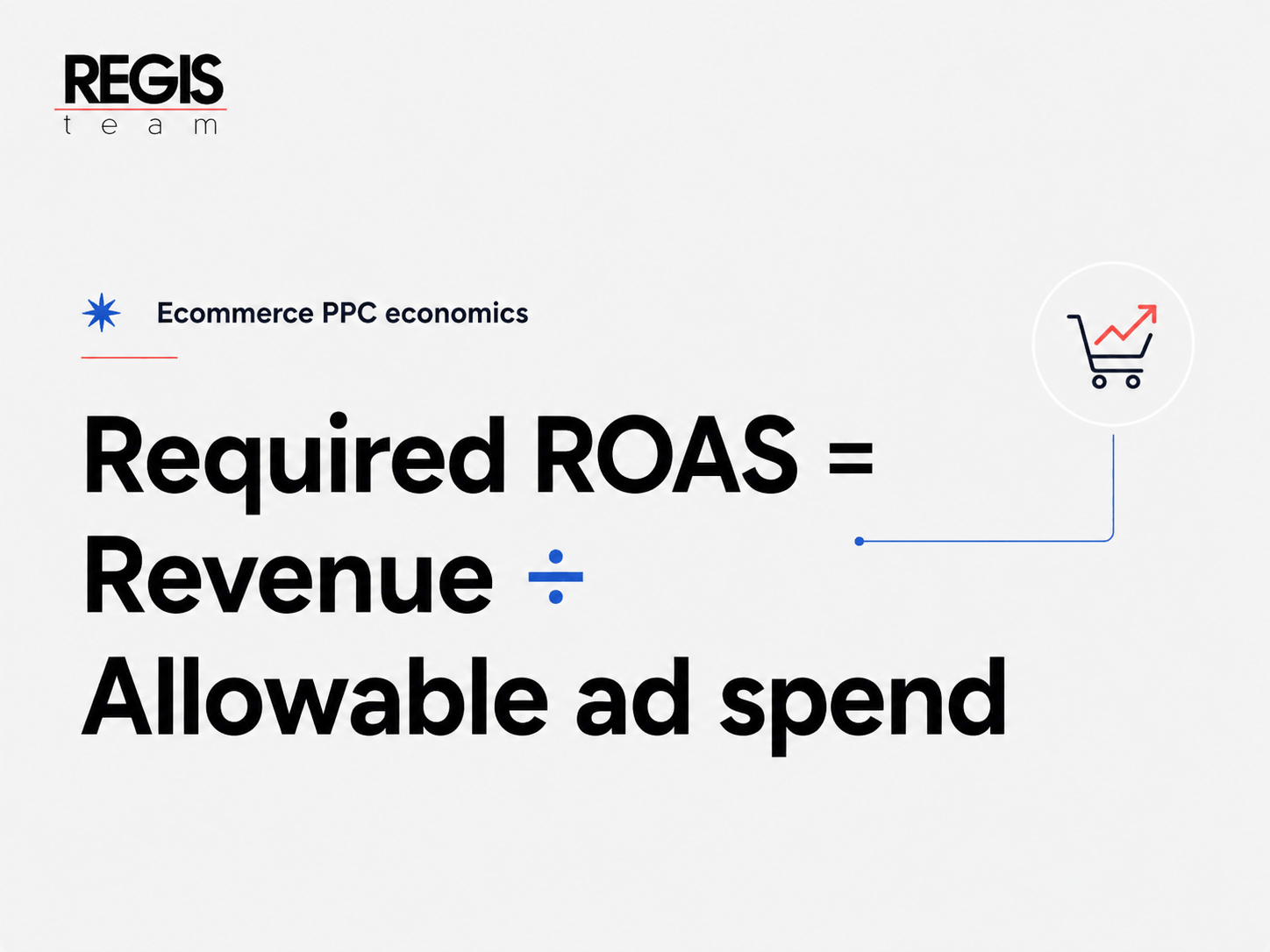
That number should come from margin, fulfilment costs, returns and the contribution the business wants to keep after acquisition.
Not Every Product Should Receive the Same Budget
Ecommerce campaigns often fail because products are treated as equal when their economics are not.
A product can have:
- high revenue but weak margin;
- strong margin but low stock;
- modest first-order value but high repeat purchase;
- plenty of clicks but no conversions.
A better allocation model is:
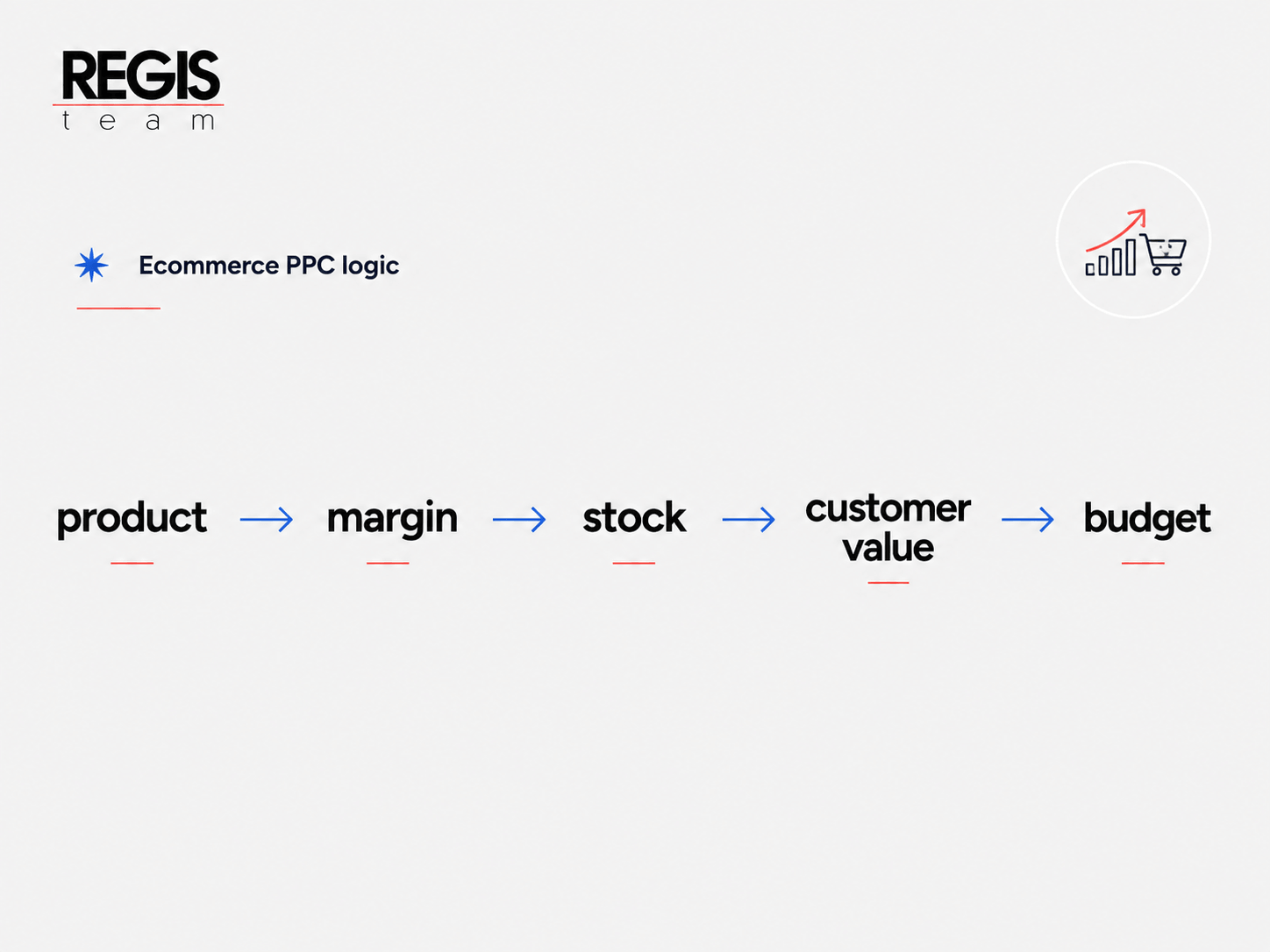
This matters especially in Shopping and Performance Max, where the feed and product mix directly influence where money goes.
Choose the Platform Around the Purchase Journey
There is no single best PPC platform.
| Platform | Best used when |
|---|---|
| Google Shopping / PMax | Customers already search for products and the catalogue is important |
| Google Search | Purchase intent is expressed through specific queries |
| Meta | Demand has to be created through creative and offers |
| Microsoft Shopping | Additional product-search demand is worth capturing |
| Amazon Ads | The purchase happens inside Amazon |
The practical question is:
Where can this store acquire profitable incremental customers?
Not:
Which platform has the most reach?
A strong agency should also be able to explain why certain products receive more budget, how branded demand is handled, and what happens when inventory or conversion values change.
Choose the Platform Around the Purchase Journey
ROAS falling does not automatically mean the bidding strategy is wrong.
Use a short diagnostic:
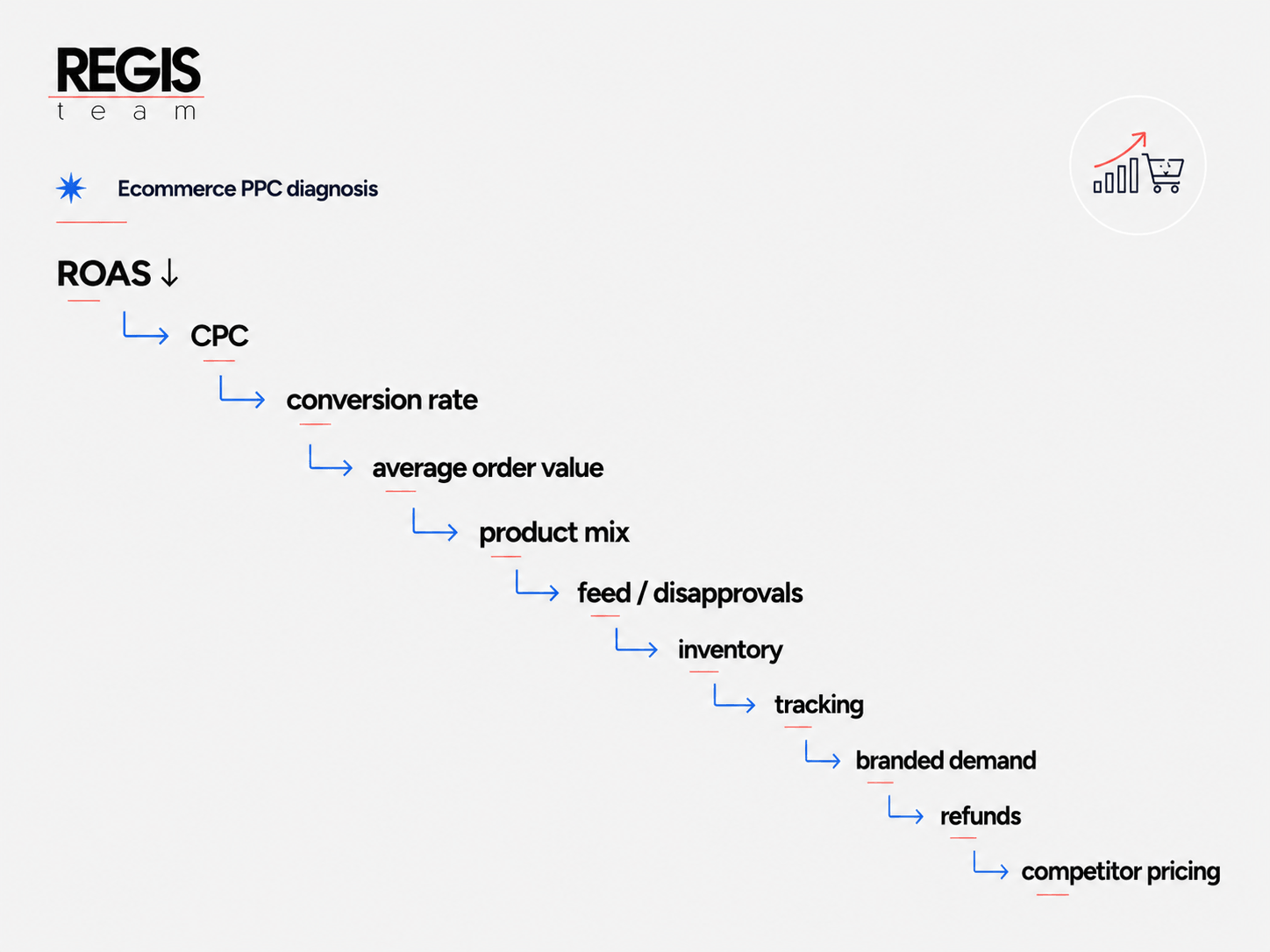
The fix should match the problem.
- Feed issue → repair product data
- Low CVR → investigate landing pages or checkout
- Stock problem → change product allocation
- Tracking problem → fix measurement
- Margin problem → reconsider target CPA / ROAS
- Creative fatigue → refresh creative
Changing bids before identifying the cause can simply increase spend on a broken system.
How to Evaluate an Ecommerce PPC Agency
A useful sales call should answer a few concrete questions:
- Can you show a comparable ecommerce case with baseline, spend, result and actual actions taken?
- How will you calculate our acceptable CPA or ROAS from our margins?
- How do you decide which products receive more or less budget?
- Who is responsible when tracking, Merchant Center or product feeds break?
- How do you separate branded demand from genuine acquisition growth?
- Who owns the ad accounts, feeds, analytics and historical data?
- What would make you recommend reducing spend instead of scaling it?
The last question is one of the most useful.
A good agency should sometimes be able to say:
“Do not scale yet.”
That usually means it is looking at business economics, not only media volume.
The Best Results Need Context
Agency results are difficult to compare when one company reports:
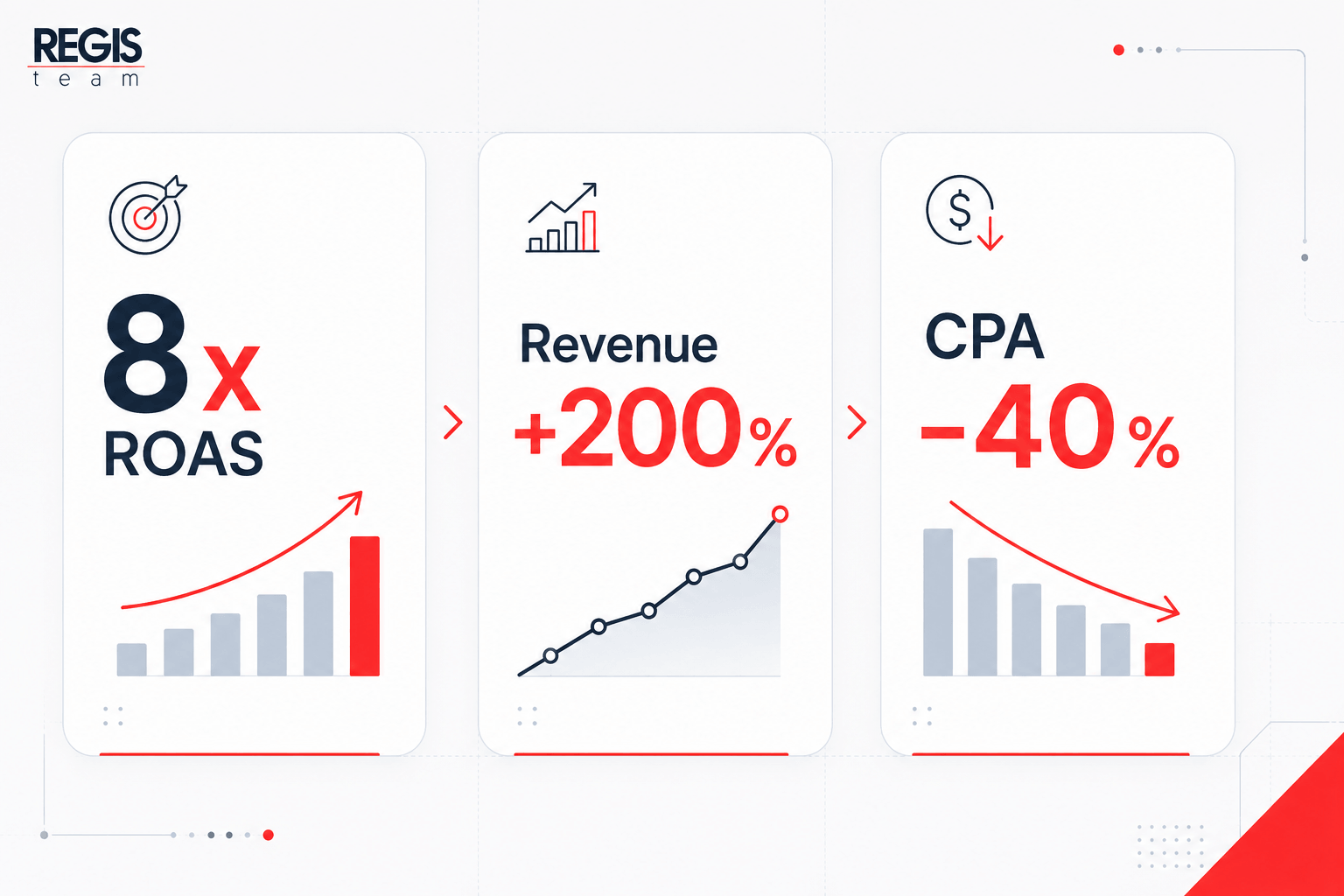
A result becomes useful only when it includes:
baseline + spend + timeframe + channel + actions + business context
That is why a detailed case study is often more valuable than a larger headline percentage.
RegisTeam, for example, publishes ecommerce cases with starting and later spend, revenue, ROAS, CPA and the account changes made between those periods. Team4eCom provides more marketplace-specific evidence around Amazon advertising. ClickSlice publishes detailed Google Ads cases, although its most detailed public examples are mainly outside ecommerce.
This does not mean agencies with less public data perform worse. It means buyers should ask for comparable evidence before making a decision.
Start With the Problem, Then Choose the Agency
The fastest way to narrow the shortlist is to identify the bottleneck first.
Campaign problem
→ PPC specialist
Traffic is good, conversion is weak
→ PPC + CRO / development
Shopping or PMax is central
→ PPC + feed / product-data expertise
Amazon is central
→ marketplace advertising + ASIN / inventory expertise
Growth works but efficiency falls when spend increases
→ agency with evidence of profitable scaling
The best ecommerce PPC partner is ultimately the one that can connect:
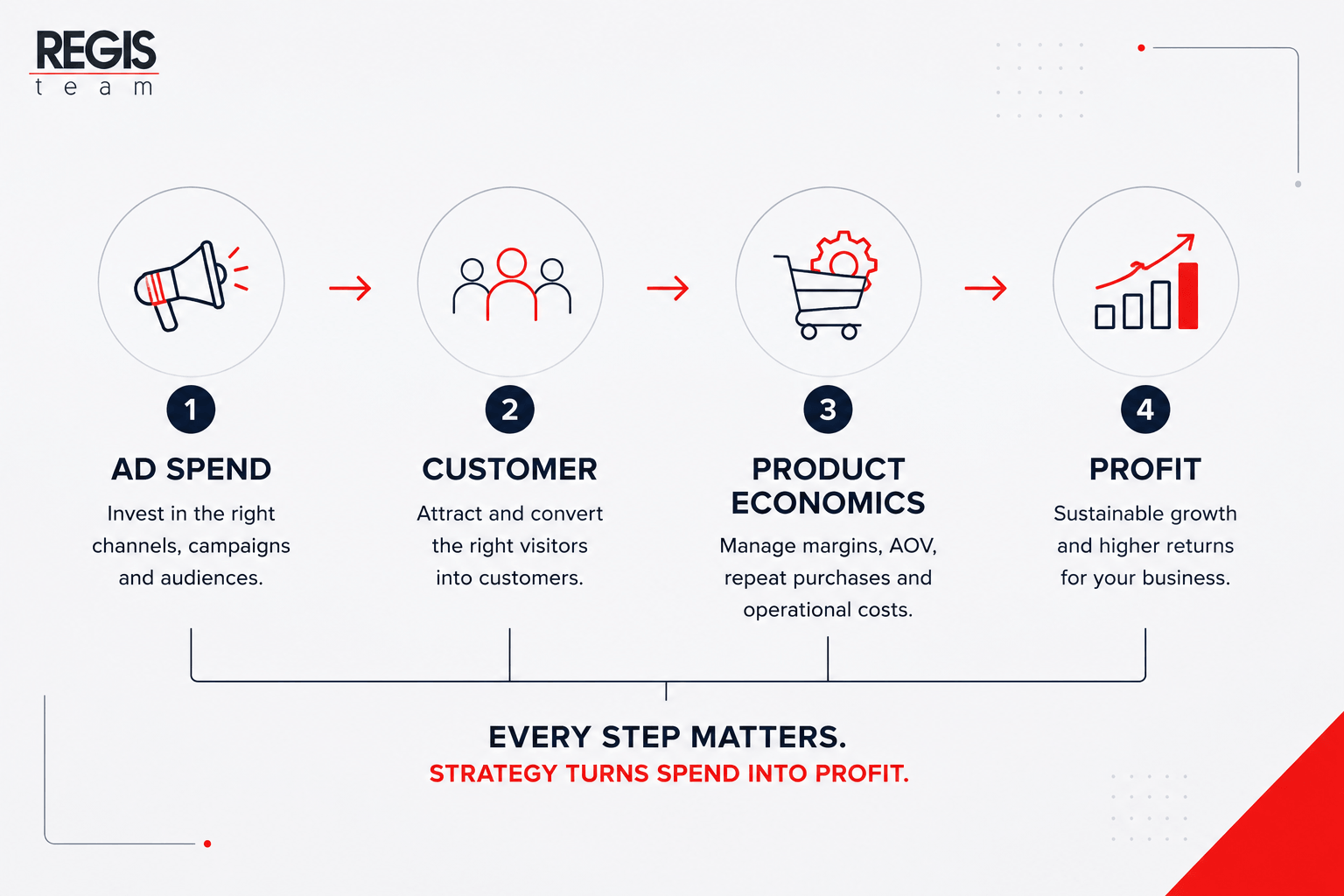
Everything else is secondary.