


Why Simply Launching Google Ads is no Longer Enough: An Interview with RegisTeam’s Head of PPC Department
Clients often come with a clear request: “We want to launch Google Ads,” “We need Meta Ads,” “We want Shopping campaigns,” “We need Performance Max,” or simply “We need leads from advertising.”
But in practice, results rarely depend only on settings inside the ad account anymore. You can bring in high-quality traffic but lose leads on a weak landing page. You can launch campaigns in Google or Meta but still not understand which inquiries actually came from advertising. You can get clicks but not see where the user gets stuck: on the form, because of an unclear offer, slow website speed, lack of trust, or the decision-making process itself.
That is why RegisTeam is developing a new performance-driven approach to PPC, where paid traffic, CRO, analytics, retargeting, and landing page testing do not work separately, but as one connected advertising system.
Valeria Subota, marketer at RegisTeam, spoke with Andrey Verkeenko, Head of PPC Department, about why ad setup alone is no longer enough, how the new OneSource and Performance+ packages work, and why the team takes responsibility not only for launching campaigns, but also for the user journey from the first click to the lead.
Andrey, why did you decide to package PPC not just as ad setup, but as a more comprehensive performance-driven approach?
Andrey Verkeenko:
Two, three, or five years ago, it was much easier to get a good return on advertising while working mainly inside the ad account.
If a business had a more or less well-packaged offer that people needed, you could launch ads for it — and it would sell. Many companies relied on this for a long time: they did not fully develop their marketing, did not work on A/B testing, landing pages, analytics, or other parts of the system.
Now the situation has changed. Competition has grown significantly, and user expectations have become higher. It is no longer enough to simply have a clear offer and drive traffic to it. This offer has to be competitive against everything our target audience sees: in ads, search, social media, and on competitors’ websites.
If the offer or landing page does not look convincing enough, then no matter how well the ads are set up, they will not work the way they should. Bringing traffic to a website has become easier, but leading the user to a lead or purchase is a completely different task.
That is why, when a business comes to us for advertising, we often see that there are indeed problems in the campaigns, but they cannot be fully solved inside the ad account alone. The limitations may be on the landing page, in analytics, in the overall traffic system, or in the approach to working with the user after the click.
You can simply let incoming traffic pass through the website, or you can actually work with it: bring the user back, warm them up, and lead them to the target action — even if they did not submit a lead or buy right away. They still remain an interested potential customer.
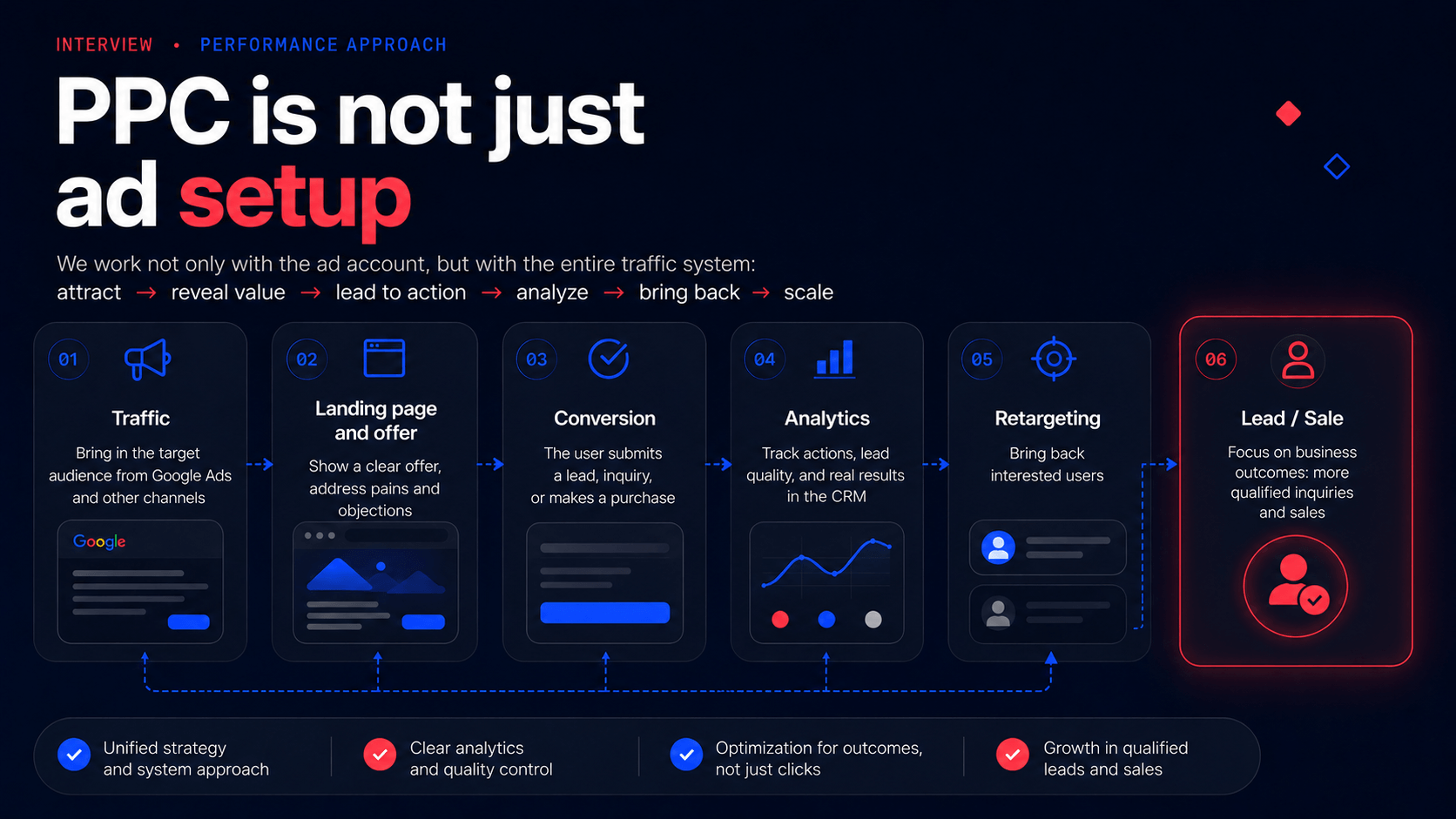
This is exactly why we are expanding our approach to PPC. Our goal is to help clients not just get clicks or nice-looking numbers in the ad account, but guide the user from the first contact with the business to a lead, a conversation with the team, or a purchase.
What do you mean when you say you work not just with the ad account, but with the entire traffic system?
Andrey Verkeenko:
Every business has certain stages a person goes through before becoming a customer. Of course, we can talk about different funnels: product funnels, content funnels, social media funnels, email funnels, and so on. There are many of them.
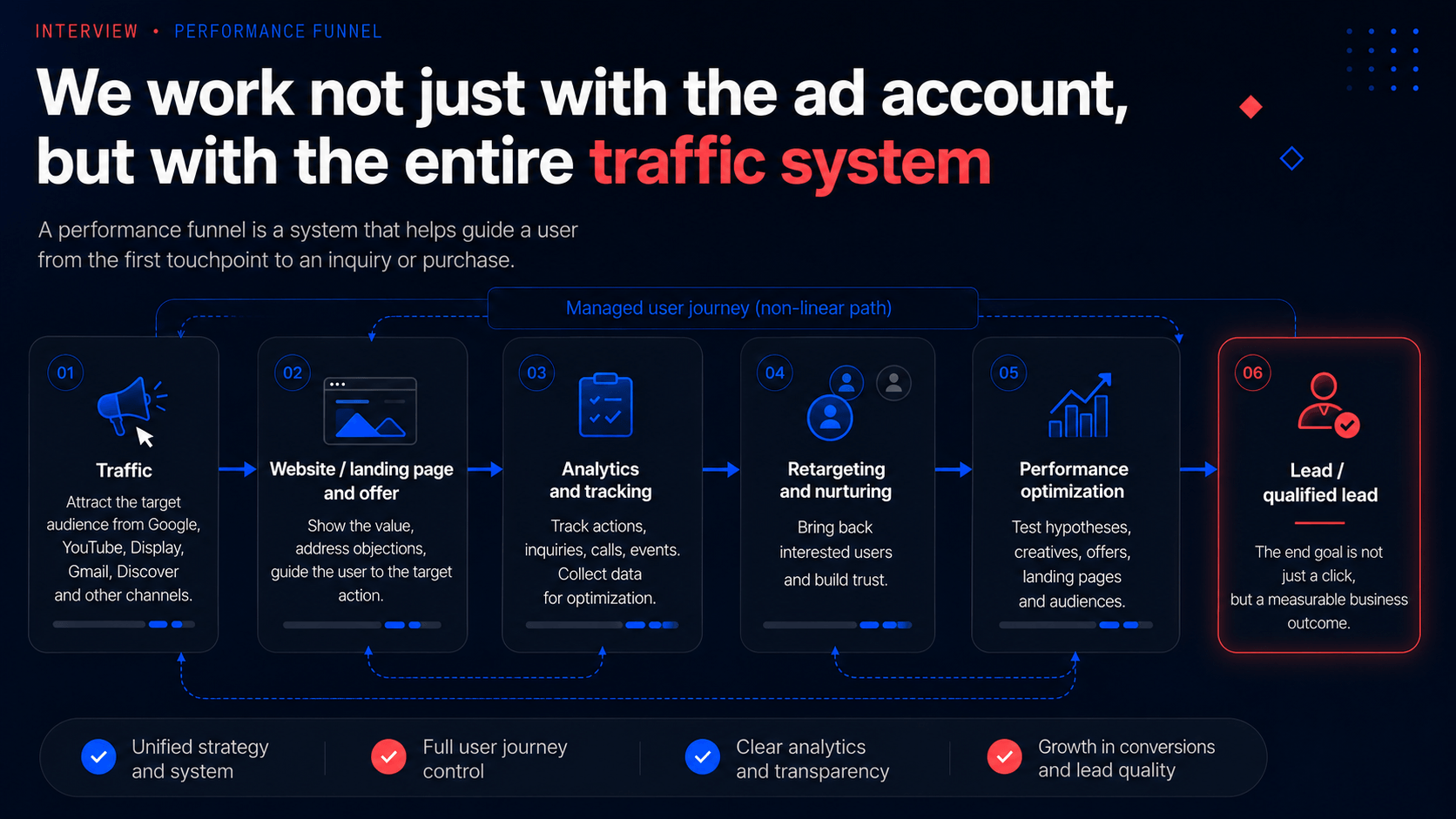
But in our case, we are talking specifically about the performance funnel. That is, a system that helps make the customer journey from the first click to a lead or purchase clearer, more predictable, and more scalable.
In a performance-driven approach, it is important to understand that the user journey is often nonlinear. Our task is to understand at which stages a person may have doubts, where they need more trust, where the offer needs to be explained more clearly, and where we need to bring them back to the purchase or lead form at the right moment.
That is why we work not only with the ad account, but with the traffic system as a whole. It needs a clear strategy: how we introduce the user to the business, what offer we show, where we send the traffic, how we track actions, how we bring interested users back, and how we guide them to the target action.
In the end, the task is not just to bring in more traffic. The task is to make sure this traffic follows a clear path and is more likely to reach a lead, the sales team, or a purchase.
And this raises an important question: if advertising brings in the audience, but there are still few leads, is the problem always in Google Ads or Meta Ads? Often, the result is lost after the click — because of a weak offer, an unclear landing page, lack of trust, or incorrect analytics.
So the problem is often not that Google Ads “doesn’t work”?
Andrey Verkeenko:
Exactly. Today, we often see situations where the advertising itself can definitely be improved. But the real growth point is not always inside the ad account alone.
For example, the landing page or offer may not be competitive enough. The business does not clearly stand out from competitors, and sometimes even looks weaker compared to them.
If the positioning, offer, and landing page are still at the level of what worked two, three, or four years ago, that may no longer be enough in today’s market. Competitors are changing, users are becoming more demanding, and the market reacts faster to new formats.
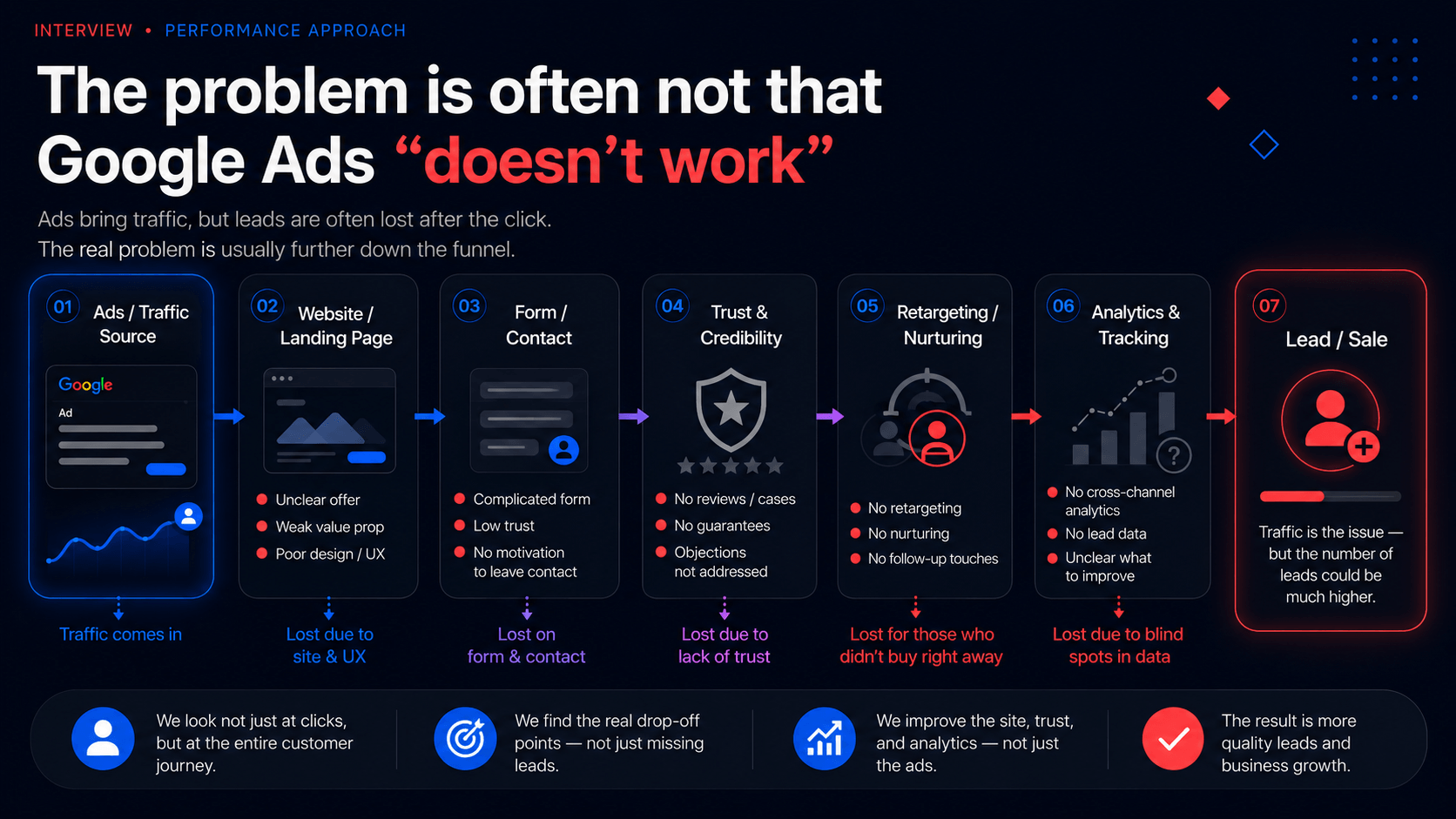
That is why we often see money being lost not at the click stage, but after it. Advertising can bring the user in, but after that, the business has to convince them to take the next step.
How is this approach packaged into the new offers?
Andrey Verkeenko:
For companies that are already actively selling online, using paid traffic, or, for example, growing organically but want to speed things up with PPC, we have developed two packages: OneSource and Performance+.
In practice, they cover the main needs of businesses that want not just to launch ads, but to build a stronger advertising system.
The first package is OneSource. It is suitable for businesses that do not always need a full omnichannel approach with Google Ads, Meta Ads, TikTok Ads, and other channels running at the same time. In some niches, one main traffic source is enough, especially when we are talking about local services or businesses where demand is already formed.
For example, there are services people rarely order through social media. If something breaks, they need to fix it quickly. If something hurts, they look for where to book an appointment and get help. In these cases, Google Ads often works best because it captures existing demand.
Within OneSource, we focus on the main traffic source, most often Google Ads, and strengthen it through Conversion Rate Optimization. In other words, we look at how the landing page can be improved so it works better with cold traffic and converts users more effectively than before.
In addition to the main traffic source, we can also add remarketing when needed. It helps bring back users who have already shown interest in the company’s service or offer, but for some reason have not completed the target action.
This package is usually a good fit for local or small businesses that need to use the most profitable traffic source and strengthen it with CRO and remarketing.
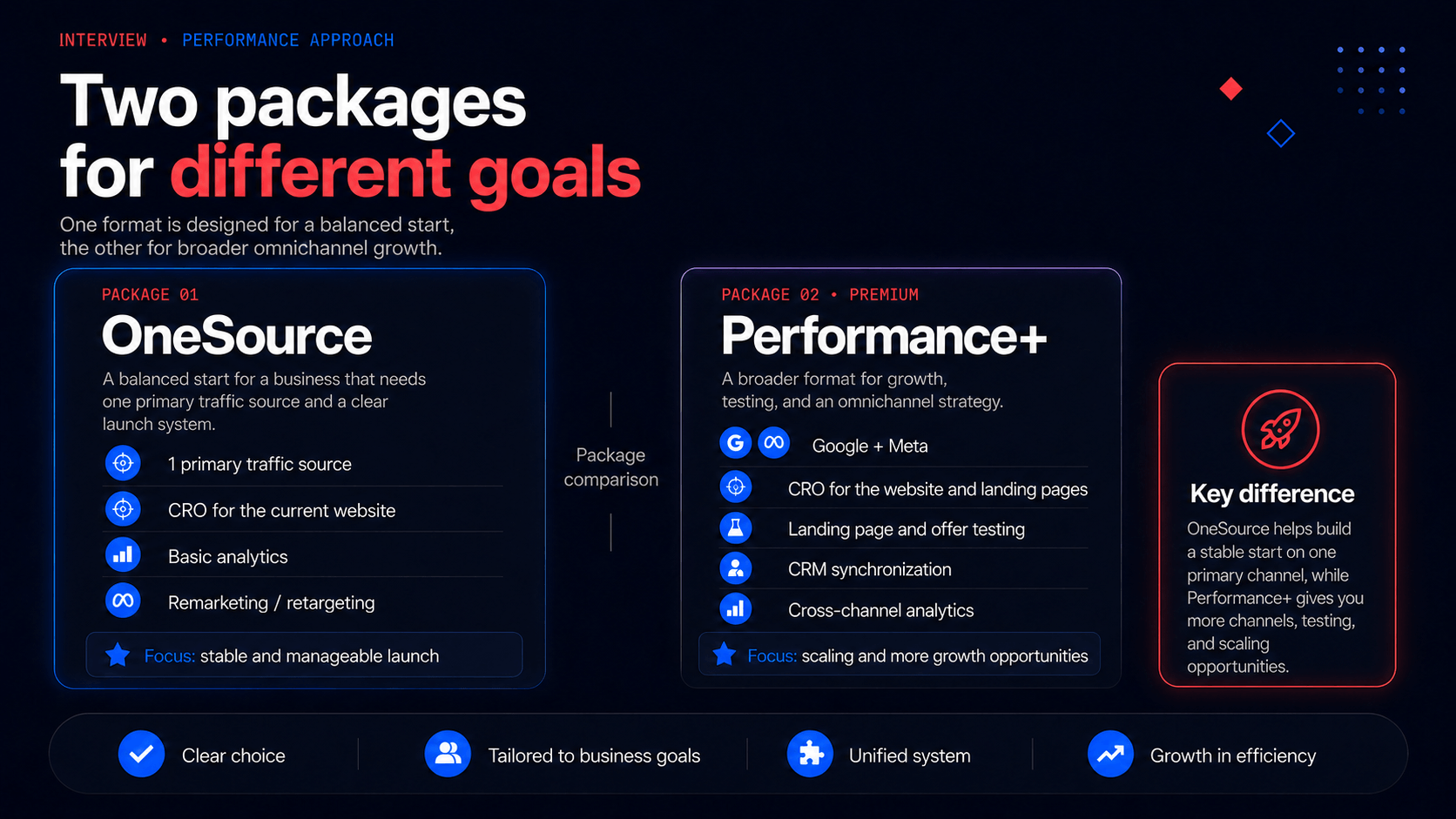
If we talk about Performance+, this is already a partnership-based omnichannel format. Here, we use both Google Ads and Meta Ads, while also regularly working on testing landing pages, offers, and advertising flows.
For example, we may test a different product page, a different hero section, or a different block structure on the landing page. We look at the analytics and change page elements to check whether the page can convert better.
The goal of Performance+ is not just to drive traffic from several sources. The goal is to combine traffic, analytics, CRO, and ongoing testing into one system that moves the user toward a lead or customer faster and helps use the overall advertising budget as effectively as possible.
To do this, decisions should not be made separately for each advertising platform. We need to look at the entire performance system as a whole. Everything works as one connected setup, and the goal of this setup is to make the overall advertising budget work as efficiently as possible.
How can a business understand which package it needs?
Andrey Verkeenko:
OneSource is a better fit for businesses that need to focus on performance here and now: getting a stable flow of leads from one main source and carefully improving the landing page so this traffic converts better.
It is a good option for companies that do not have large budgets, do not need a full omnichannel launch, or where, for example, Meta Ads does not work very well as a separate channel. In this case, there is no point in connecting several traffic sources right away if the required number of leads can be generated through one main channel.
Performance+ is a better fit for companies that are ready to grow more actively: businesses that need a larger volume of clients, need to work with several channels, regularly test hypotheses, improve landing pages, and systematically strengthen the entire advertising setup.
This format is for businesses that want to keep developing the system: analytics, CRO, tests, offers, retargeting, and new advertising flows.
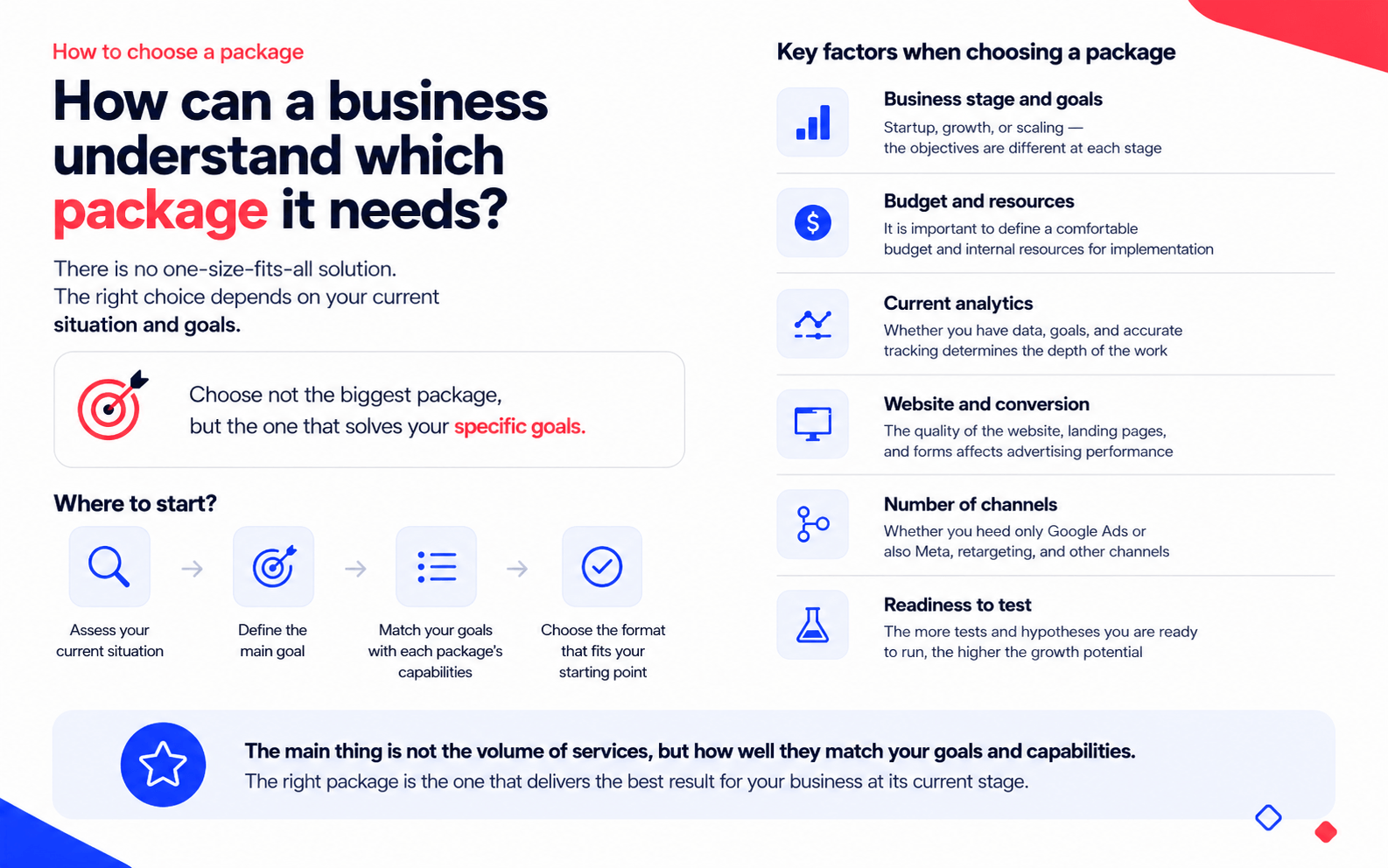
The key is not to choose the biggest package, but the one that matches the business goal, current stage, budget, and real ability to handle incoming leads.
What would you recommend to a business that wants more leads but does not understand where exactly it is losing results?
Andrey Verkeenko:
If a business wants more leads, clients, and sales, the first thing to start with is an audit. We need to understand where the current limitation is and why the business is not getting the result it wants.
Sometimes a company comes to us, and its advertising system is generally in good shape. Traffic pays off, leads are coming in, but the business simply has not seen its real growth area and/or has not calculated it in numbers.
In other cases, the problem is indeed inside the ad account. For example, Google Ads may bring a lot of irrelevant or “junk” traffic, while in Meta Ads, the creatives may perform poorly, or the algorithm may have learned on the wrong audience core.
In such cases, of course, we solve traffic-related issues: settings, campaign structure, creatives, audiences, and lead quality.
But there is another situation too: the ad accounts are more or less fine, while quality traffic is being lost on the landing page. The user arrives, shows interest, but the page does not convince them to submit a lead, make a purchase, or take the next step.
So the universal advice is this: first, do not choose a campaign or channel. Instead, understand where the growth point is at the current stage of the business. It may be the ad account, the offer, the landing page, analytics, retargeting, lead quality, or how the business works with the user after the first contact.
For this, we have two audit formats. The first is a free express audit of the ad account and landing page. Within a few days, we go through the most painful points and highlight where leads may be getting lost.
The second is a full audit that takes dozens of hours. There, we analyze ad accounts, landing pages, analytics, competitors, and the entire performance setup in more depth to understand what exactly is blocking growth and which action plan will be optimal.
In short: what is the main thing a client should understand about RegisTeam’s new performance-driven approach?
Andrey Verkeenko:
The main thing is to understand that today, businesses often need more than just a traffic contractor who will “set up Google Ads.” They need a partner who can help figure out how the entire advertising system works toward the result.
Everything is changing quickly now: competitors, user behavior, advertising algorithms, creative formats, and audience expectations. So even if a business has found something that used to work or works right now, it cannot stop there. It needs to keep moving forward and finding even more effective approaches.
This is where we help, and this kind of partnership brings much more money to the business. In this system, Google Ads is one of the tools for reaching the goal, not the solution in itself.
This is the core of our performance-driven approach: not just launching ads, but continuously improving the entire setup that leads the user from the first contact with the business to a lead, a purchase, or a conversation with the sales team.
Conclusion
Launching ads by itself no longer guarantees results. A business needs to understand not only how many people came to the website, but also what happened after the click: whether the user saw a clear offer, reached the form, submitted a lead, whether the lead got into the CRM, and whether the result can be connected to a specific channel.
That is why RegisTeam’s performance-driven approach combines PPC, CRO, analytics, retargeting, and landing page testing into one system.
If you want to understand where inquiries are currently being lost — in advertising, on the website, in analytics, in the offer, or on the landing page — the RegisTeam team can run an initial assessment of your advertising setup and suggest a clear launch plan.


