Best SEO Agency for Shopify for Technical SEO and AI Discovery
Shopify has moved well beyond being a platform for small online stores. The company says millions of merchants now use Shopify across more than 175 countries, cumulative gross merchandise volume has passed $1.6 trillion, and Shopify merchants account for more than 14% of U.S. ecommerce sales. In Q1 2026 alone, merchants processed more than $100 billion in GMV through the platform.
The search environment around those stores is changing just as quickly. Adobe found that AI-referred traffic to U.S. retail sites grew 393% year over year in the first quarter of 2026. By July, AI-referred retail visitors were converting at a 60% higher rate than non-AI visitors and adding products to carts at a 28% higher rate.
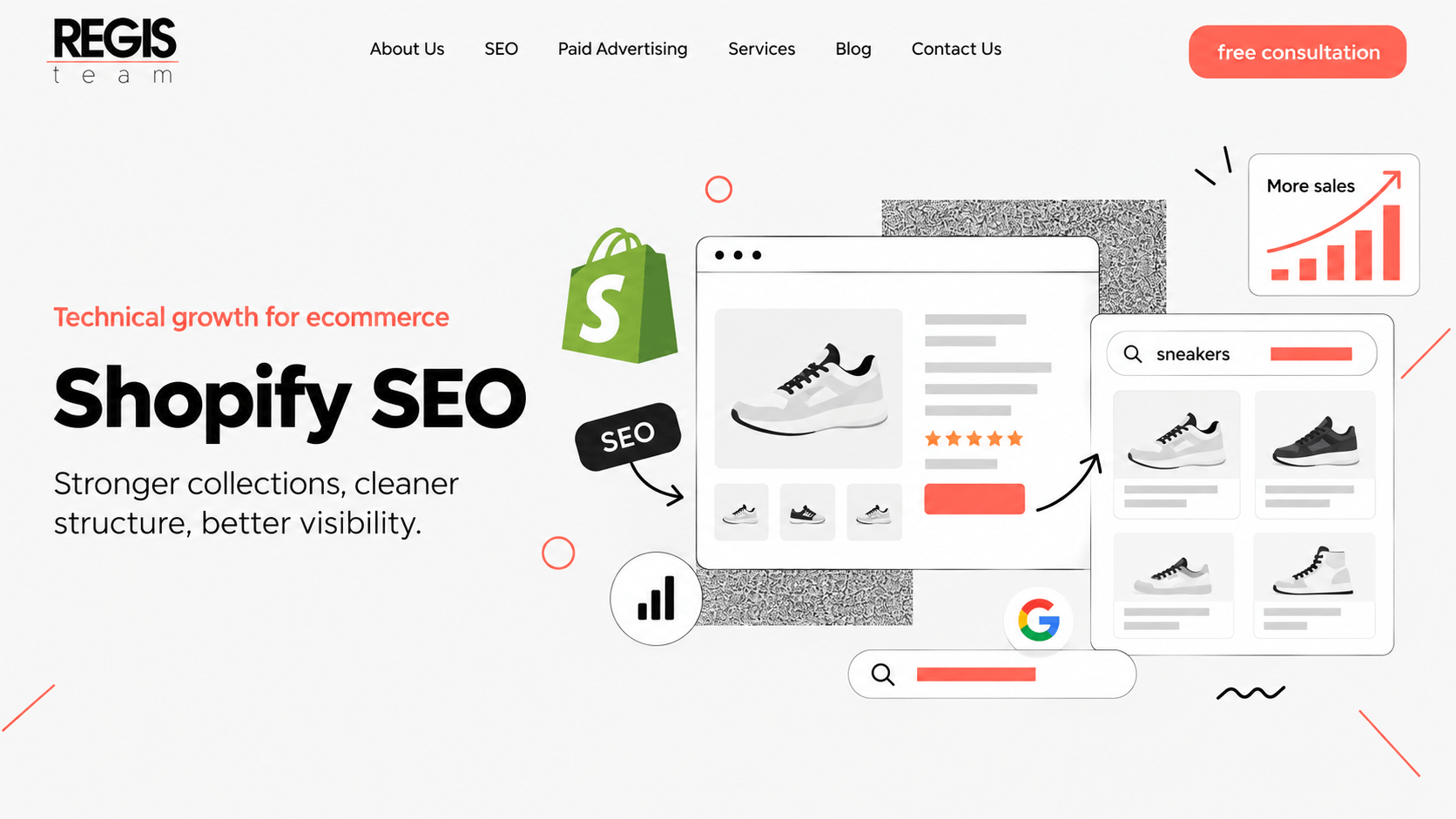
That makes evaluating Shopify SEO agencies more complex than simply comparing firms that offer keyword research, content and backlinks. Search visibility increasingly extends into product data, AI-assisted discovery, collection architecture, feeds, structured data and the technical relationship between Shopify and external discovery systems.
There is no universal best Shopify SEO company for every store, so the companies below are not ranked. They represent different approaches to organic ecommerce growth, from technical Shopify work and catalog expansion to CRO, development and AI visibility.
Shopify SEO at a glance in 2026
Here are the key data points shaping Shopify SEO in 2026:
| Signal | Verified data | Why it matters |
|---|---|---|
| Shopify ecosystem | Millions of merchants in 175+ countries | Shopify-specific search problems now exist at significant scale |
| Cumulative Shopify GMV | More than $1.6 trillion | Organic product discovery can influence substantial commercial demand |
| U.S. ecommerce share | More than 14% according to Shopify | Shopify is a material part of the U.S. ecommerce market |
| Q1 2026 GMV | More than $100 billion | Large catalogs and growing merchants increasingly need scalable search systems |
| AI retail traffic | +393% YoY in Q1 2026 | Product discovery is expanding beyond classic SERPs |
| AI-referred conversion | 60% higher than non-AI traffic in July 2026 | AI visibility can represent commercially valuable traffic, not only brand exposure |
Sources: Shopify Investor Relations and Adobe Digital Insights.
RegisTeam
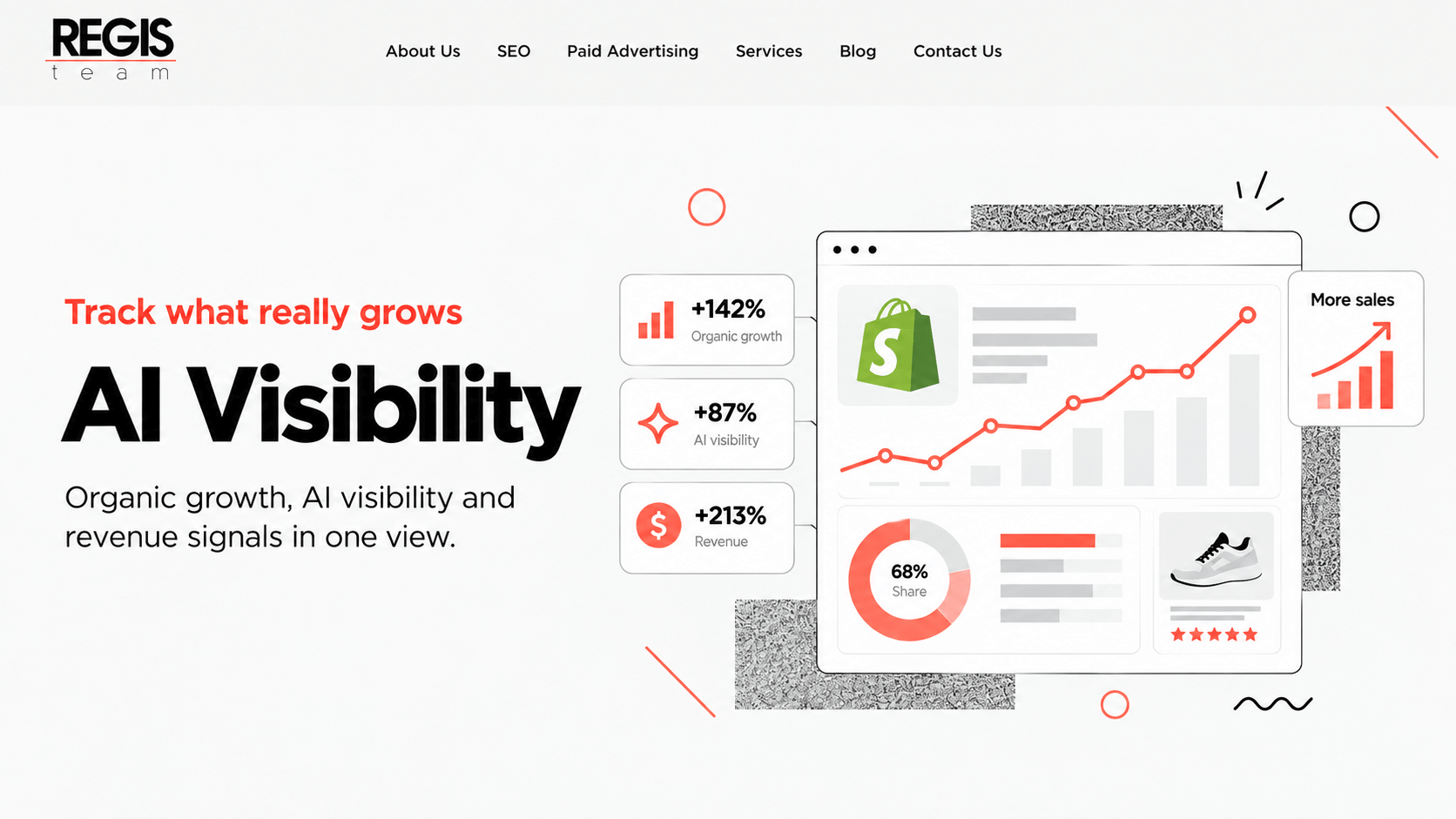
RegisTeam is a Shopify SEO agency that combines conventional ecommerce optimization with technical SEO and a dedicated AI visibility practice.
Its public Shopify case study reports 155% organic traffic growth for a cosmetics store following work on site structure, content and technical optimization. RegisTeam also publishes ecommerce cases beyond Shopify. This broader ecommerce experience is useful for projects where the main constraint is not the CMS itself but catalog architecture, semantics or search visibility across a large commercial structure.
Related reading on this topic:
How to grant a developer access to Shopify without sharing a password
155% Growth in Organic Traffic
The more distinctive element is the agency’s work beyond traditional Google rankings. In a separate ecommerce project, RegisTeam reports more than 7,000 AI responses and more than 2,500 pages used as sources by AI systems following the implementation of an AI visibility strategy. Visibility growth was recorded across Google AI Mode, AI Overviews, Grok and other generative platforms. The work included Entity SEO, authorship, structured data, internal linking, technical AI discoverability, and content restructuring.
This gives RegisTeam a useful combination for Shopify projects:
catalog SEO → technical implementation → commercial content → organic visibility → AI discoverability
Rather than treating AI visibility as a replacement for SEO, the model extends existing ecommerce optimization into the discovery layer.
Proactive Online Marketing
Proactive Online Marketing has a dedicated Shopify service built around a more hands-on SEO model. Its public materials cover keyword and content planning, technical audits, product and collection optimization, internal linking, authority building, and analytics tied to conversions rather than rankings alone.
The business also emphasizes direct access to the person managing the strategy rather than a multi-layer account-management structure. That makes its operating model notably different from larger integrated agencies.
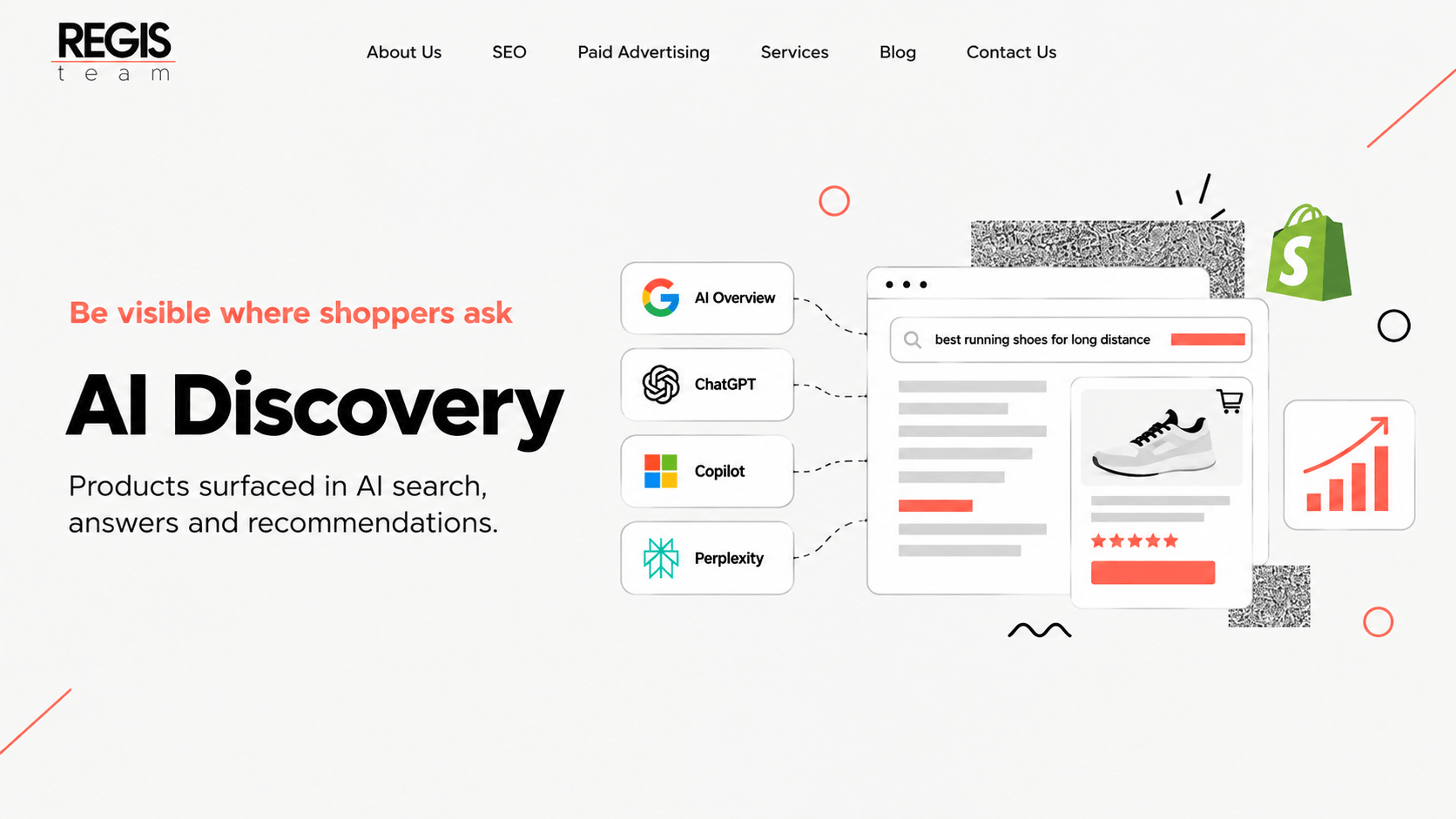
Its Shopify content covers platform-specific subjects such as automatic canonical tags, collection and product architecture, Merchant Center setup and Shopify’s technical limitations.
The overall emphasis is conventional organic growth with direct execution rather than a large cross-channel ecommerce stack.
The Marketing Agency
The Marketing Agency positions Shopify SEO as part of a wider ecommerce system rather than an isolated traffic channel.
Its public Shopify offering covers product and collection optimization, technical SEO, content architecture and internal links, but also connects the work to CRO, analytics, Klaviyo and structured product data for Google Shopping. The company also works with Shopify Plus and handles SEO during migrations.
This integrated approach is relevant because many Shopify growth constraints span multiple disciplines. A collection may have sufficient search demand but weak UX; a technically sound PDP may still have incomplete product data; a replatforming project can improve the storefront while simultaneously destroying existing search equity if redirects and indexation are mishandled.
The Marketing Agency’s public positioning is therefore closer to SEO as ecommerce infrastructure than to a standalone content program.
SeoLogist
SeoLogist combines Shopify-specific ecommerce SEO with a broader AI-ready search offering.
Its Shopify service describes work on technical optimization, site architecture, products, collections, commercial search intent and conversion-focused content. The wider service stack includes AI SEO, Answer Engine Optimization, Generative Engine Optimization and AI Overviews optimization.
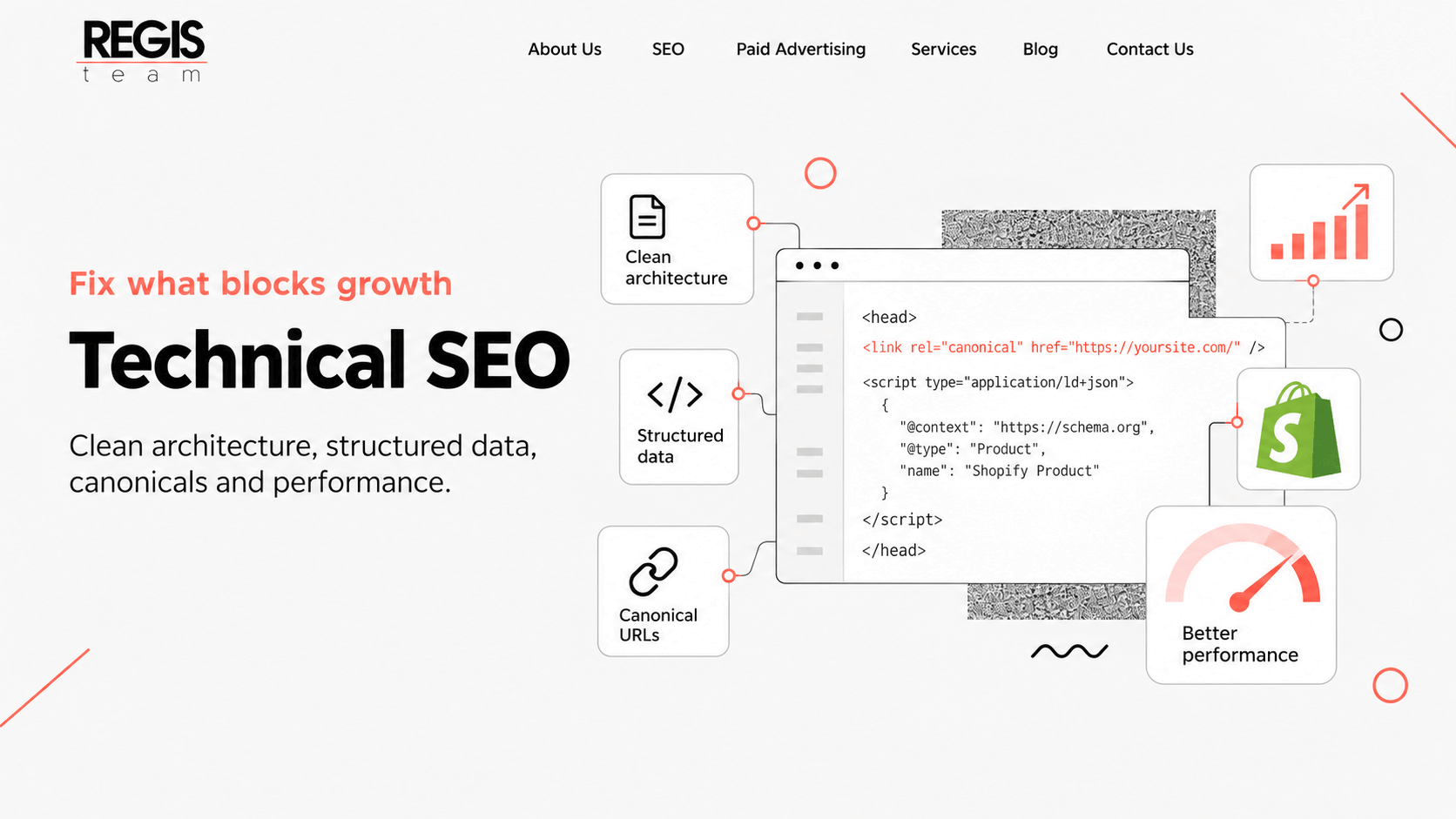
That broader approach is notable because the company’s public methodology connects schema, crawl budget, entity mapping, content clusters, AI citations and programmatic SEO rather than treating every search problem as a content-writing problem.
For Shopify stores with large taxonomies or broader North American search campaigns, its positioning extends beyond individual product-page optimization to the broader structure that supports the entire organic channel.
Lean Scale Media
Lean Scale Media combines Shopify SEO with Google Ads and Meta advertising as part of a full-funnel ecommerce model. Its organic service includes technical optimization, on-page work, off-page SEO, and content marketing.
Its published Shopify material is more specific than the standard service checklist. The company discusses how collection and product pages serve different search roles, as well as duplicate Shopify paths, canonicals, internal linking and indexed filters or tag pages.
That makes its content useful for merchants whose problems lie primarily in commercial page architecture rather than purely editorial traffic.
The broader service model also means organic search can be considered alongside paid acquisition instead of being measured in isolation.
Whole Design Studios
Whole Design Studios is distinctly Shopify-focused. Its service mix combines organic search with Shopify design, development, PPC, Klaviyo, UGC, affiliate marketing and performance optimization. Its Shopify Partners profile also lists SEO, theme work, store migration and site performance among its specialized services.
The practical advantage of that setup is the proximity between search work and storefront implementation.
For example, site architecture, template changes, conversion improvements and speed optimization can require theme-level work rather than another recommendation in an SEO document.
The company is particularly associated with ecommerce design and marketing, including fashion, apparel and other visually led Shopify categories.
Optimum7
Optimum7 sits at the intersection of ecommerce development and organic marketing.
Its Shopify Plus offering combines technical audits, content development and authority building with Shopify development, migrations and CRO. The company also works across Shopify, BigCommerce, WooCommerce, Magento and custom ecommerce development.
That development depth changes the type of Shopify work it can address. Search problems involving replatforming, custom functionality, templates or technical debt sometimes require engineering work before content optimization can have much effect.
Optimum7 also explicitly connects SEO with migration protection. That is an important distinction for established stores because a platform move introduces a different problem from ordinary ongoing optimization: preserving URLs, signals and organic demand while the underlying commerce environment changes.
Grizify
Grizify is built almost entirely around the Shopify ecosystem.
Its broader offering spans store builds, redesigns, store management, marketing, conversion work and organic search. The SEO service itself covers audits, competitor analysis, keyword research, product optimization, technical SEO, structured data and content work.
One useful distinction is that its wider Shopify service also includes Google Shopping setup and ecommerce configuration.
That connection matters because modern organic product visibility no longer ends with the HTML product page. Google increasingly relies on structured product information and commerce data to understand which products and variants are available and at what price.
Grizify therefore represents the end-to-end Shopify specialist model rather than a general search firm that happens to support Shopify.
Savit Interactive
Savit Interactive offers Shopify optimization as part of a much broader organic-search stack that includes ecommerce SEO, international SEO, AI SEO and GEO, alongside Shopify development.
Its Shopify work includes keyword research, technical optimization, product and category pages, content, link acquisition and Shopify app configuration. The public process also includes CRO and ongoing performance monitoring rather than ending at indexation or rankings.
That broader service range becomes useful for stores that operate internationally or expect their search strategy to extend into generative discovery as well as traditional Google results.
The company also offers dedicated Shopify development capabilities, allowing some technical changes to be handled within the same service ecosystem.
AI visibility is becoming measurable
A year ago, AI visibility reporting was often based almost entirely on third-party monitoring.
That changed in 2026.
Google introduced dedicated Generative AI performance reporting in Search Console for impressions within AI Overviews, AI Mode and generative features in Discover. On August 31, 2026, Google confirmed that the reporting had rolled out to websites worldwide.
For ecommerce teams, reporting can therefore be separated across several layers:
| Layer | Useful signal |
|---|---|
| Traditional search | Non-brand clicks, commercial rankings, organic revenue |
| Catalog | Indexed collections, PDP coverage, crawl efficiency |
| Product data | Variant, availability, price and feed consistency |
| Google AI Search | Generative AI impressions in Search Console |
| Other AI systems | Brand/product mentions, citations and referral sessions |
| Commerce | Add-to-cart, conversion rate, revenue |
This is more informative than treating every increase in organic sessions as equivalent.
One important correction to the AI SEO conversation
Google’s 2026 guidance is unusually clear on one point.
“The best practices for SEO continue to be relevant,”
Google says there are no additional technical requirements for appearing in AI Overviews or AI Mode beyond the requirements of normal Google Search. It also specifically says that unnecessary AI text files such as llms.txt are not required for its generative Search features. Google’s June documentation update clarifies that maintaining an llms.txt file neither positively nor negatively affects visibility in Google Search.
That does not mean all AI optimization is redundant. ChatGPT, Shopify Catalog, Gemini, Copilot and other AI and commerce surfaces operate within different ecosystems.
It means the work should be tied to a real mechanism for retrieval, product data or measurement rather than sold simply because a tactic has “AI” in its name.
Expert view
The biggest change in Shopify SEO isn’t that conventional optimization has stopped working. It’s that the boundary of what needs to be optimized has expanded.
Google still needs crawlable pages, strong architecture, useful content, and valid structured data. Shopify now exposes products to agentic shopping channels. Google can measure visibility inside generative Search. Adobe’s retail data shows that traffic from AI discovery is already behaving differently from conventional traffic.
That creates a broader operating model:
SEO foundation + catalog architecture + product data + commercial content + AI discoverability + revenue measurement
Searches around queries such as “best Shopify SEO experts agency” increasingly point toward this broader need rather than simple rank tracking.
Even an awkward search query such as “seo agency shopify” often represents the same underlying need: a partner that understands the commerce platform itself, not only generic SEO.
The companies reviewed here approach that problem differently. RegisTeam connects Shopify and ecommerce SEO with measurable AI visibility; Proactive Online Marketing emphasizes direct hands-on execution; The Marketing Agency combines search with CRO and commerce infrastructure; SeoLogist brings an AI-ready search architecture; Lean Scale Media connects organic and paid growth; Whole Design Studios combines Shopify design and marketing; Optimum7 brings development depth; Grizify offers an end-to-end Shopify service model; and Savit Interactive combines Shopify optimization with broader international and AI search services.
The useful question is no longer who can promise more rankings. It is which parts of the modern Shopify discovery system a team can actually influence, implement and measure.