On October 21, 2026, the PHP development team released emergency security updates to address two critical vulnerabilities known as PHP2Shell. The threat was considered so serious that government agencies and major companies around the world began temporarily taking their websites and online services offline to prevent potential attacks.

The shutdowns affected government portals in several European countries, as well as certain services operated by the BBC, the Wikimedia Foundation, telecommunications company Orange, and other organizations.

For online store owners and businesses with corporate websites, this news may seem far removed from everyday business concerns, especially if PHP is something you normally leave to developers.

However, the issue isn’t limited to major corporations. Smaller websites running vulnerable versions of PHP may also be at risk. In this article, we’ll explain what happened, why PHP2Shell has attracted so much attention, what risks it poses to businesses, and how to check whether your website is protected.

What Is PHP2Shell and Why Is It Dangerous?

PHP2Shell is the collective name for two critical vulnerabilities in PHP itself*:

  • CVE-2026-109618 — a memory-related flaw that can occur under certain conditions when request processing terminates unexpectedly.
  • CVE-2026-109619 — a memory management flaw involving the possibility of accessing memory that has already been freed (use-after-free).

Both vulnerabilities received a critical severity score of 9.2 out of 10 under CVSS 4.0 (the Common Vulnerability Scoring System).

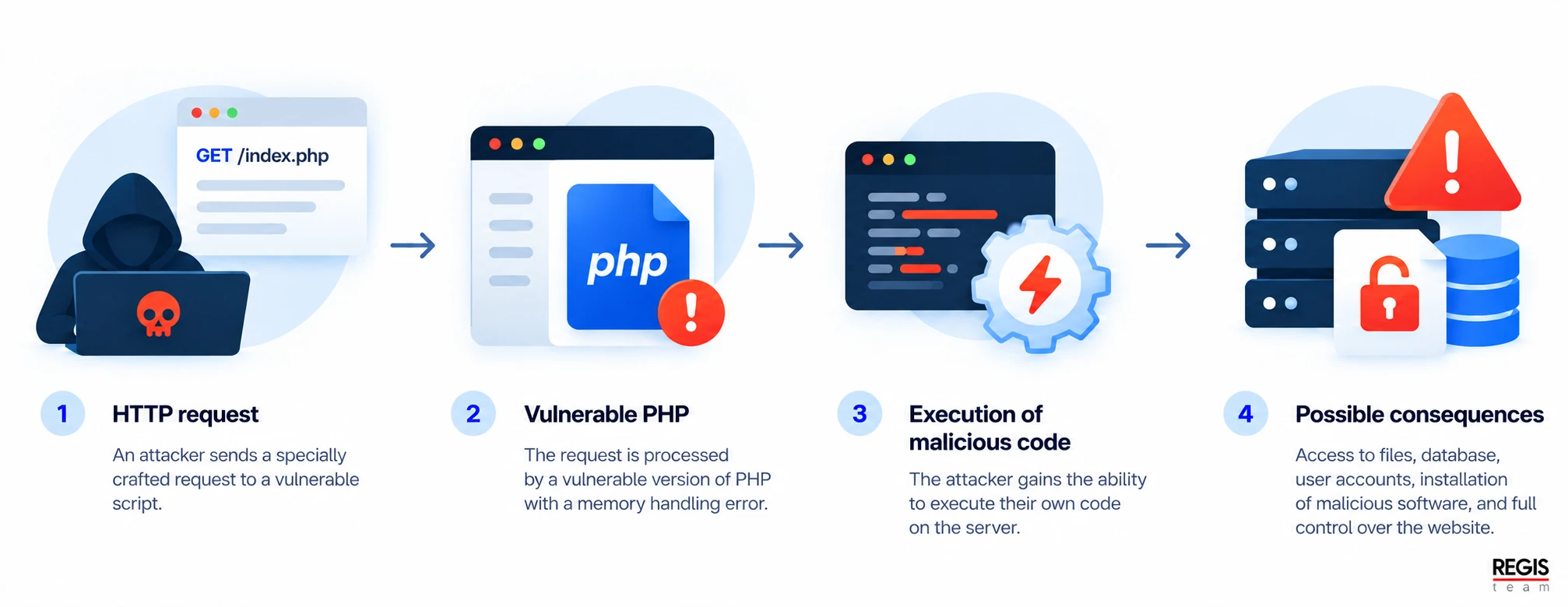
Under certain conditions, successful exploitation of these vulnerabilities could allow attackers to remotely execute arbitrary code on a server without prior authentication.

*PHP is one of the most widely used server-side programming languages. It powers WordPress, OpenCart, Magento, Drupal, Laravel, and many other platforms. According to W3Techs, PHP is used by nearly 70% of websites whose server-side programming language can be identified.

Website security issues are usually associated with outdated plugins, weak passwords, or development mistakes. This time, however, the situation is different.

And the risk is more than theoretical. According to Amazon Threat Intelligence, the first attack attempts were detected as early as October 17, four days before the security patches were released. Cybersecurity researchers later confirmed successful exploitation of the vulnerabilities, and the US Cybersecurity and Infrastructure Security Agency (CISA) added both CVEs to its Known Exploited Vulnerabilities catalog.

In simple terms, attackers may not even need an administrator password to target a vulnerable website. Here’s a quick overview of how it works:

The issue isn’t limited to a specific plugin or CMS. It affects a technology that powers a significant portion of the modern web.

PHP Shutdown: How a Critical Vulnerability Disrupted Web Services Worldwide

The scale of the threat became clear on October 21, 2026, when reports of PHP2Shell triggered a wave of emergency shutdowns across government and commercial websites.

Government agencies and major companies began temporarily restricting access to certain websites and online services while their technical teams prepared and installed security patches. The result was effectively a widespread, precautionary shutdown of PHP-powered services around the world.

Which Countries and Organizations Were Affected?

In France, websites operated by regional prefectures, the Paris Police Prefecture, and several government agencies were temporarily taken offline. Telecommunications company Orange SA also restricted access to some of its websites and applications.

Germany, Belgium, and the Netherlands temporarily suspended access to certain government portals and online services. German authorities emphasized that the shutdowns were precautionary.

In the United Kingdom, the BBC temporarily took several of its web portals offline. Similar measures were introduced by some local authorities, including Edinburgh.

In Japan, the restrictions affected government online services, financial institutions, and transportation companies, including Nomura, Mitsubishi UFJ Financial Group, ANA, and East Japan Railway. The situation attracted so much attention that Japanese Prime Minister Sanae Takaichi publicly called for checks of PHP usage on publicly accessible websites.

Major international online platforms, including the Wikimedia Foundation and the Internet Archive, also temporarily restricted access to certain services while security updates were being installed.

The threat had clearly spread far beyond Europe.

PHP2Shell became a global issue, highlighting just how dependent even the largest organizations are on the security of core web technologies.

Why Were Websites Taken Offline Even If They Hadn't Been Hacked?

The widespread shutdowns don’t mean that all the affected websites had been compromised. In many cases, organizations proactively restricted access to potentially vulnerable systems to protect them until security patches could be installed.

This is a standard approach to managing critical cybersecurity risks: if a system can’t be secured quickly, temporarily taking it offline may be the safer option.

And while even a few hours of downtime can mean lost orders and revenue for a business, the consequences of a successful cyberattack can be far more costly.

The key takeaway is clear: if even major government agencies and technology companies considered it necessary to temporarily restrict access to their services, owners of commercial websites have every reason to take security checks seriously.

Which Websites Are at Risk?

PHP2Shell could potentially affect any website or web application running a vulnerable version of PHP without the necessary security patches. These may include:

  • E-commerce websites built on WordPress/WooCommerce, OpenCart, Magento, and other PHP-based platforms.
  • Corporate websites running on WordPress, Drupal, or custom-built CMS platforms.
  • Web applications and customer portals developed using Laravel, Symfony, and other PHP frameworks.
  • B2B portals and internal business systems accessible over the internet.
  • Websites running outdated server environments that haven’t received security updates in a long time.

However, using PHP doesn’t automatically mean a website is vulnerable. The key factors are the PHP version, whether the necessary security patches have been installed, and the server configuration.

Which PHP Versions Should You Check?

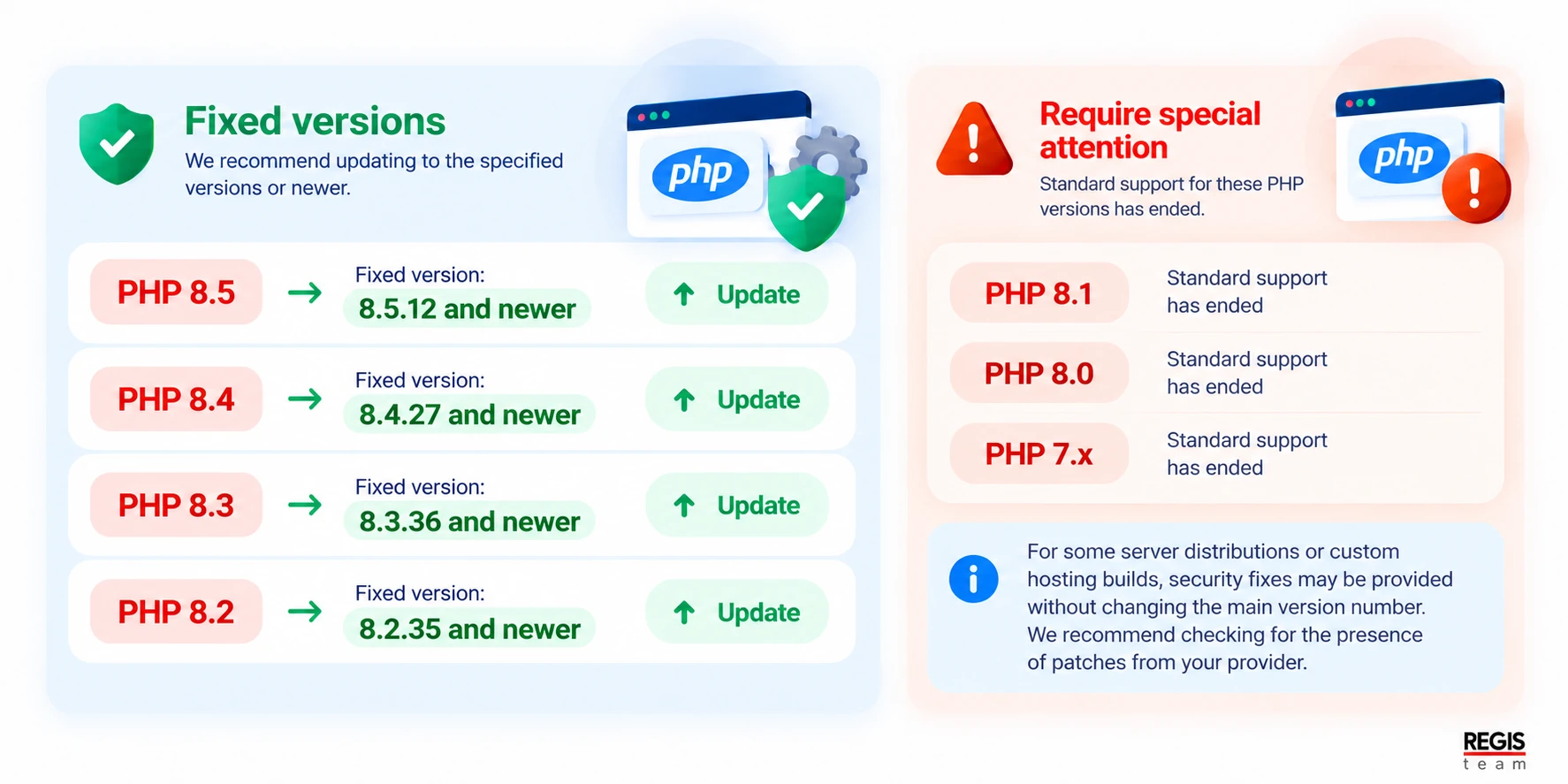
Official security patches for the PHP2Shell vulnerabilities are available in the following PHP versions:

PHP BranchPatched Version
PHP 8.58.5.12 and later
PHP 8.48.4.27 and later
PHP 8.38.3.36 and later
PHP 8.28.2.35 and later

Older PHP branches, including 8.1, 8.0, and 7.x, require special attention because official support for these versions has ended. Some server distributions and hosting providers may backport security patches without changing the main PHP version number.

That’s why simply checking the PHP version displayed in your hosting settings isn’t enough to reliably determine whether your website is protected.

How PHP2Shell Can Affect Your Business

For technical specialists, a critical vulnerability primarily means the risk of arbitrary code execution, unauthorized access to server memory, and compromised infrastructure.

For business owners, the consequences are much more tangible.

1. Website Downtime and Lost Orders

If an attack succeeds, attackers could potentially disrupt website operations or gain access to server resources. For an online store, this could mean customers being unable to browse the product catalog, use the shopping cart, or complete checkout.

For example, if an online store processes 100 orders per day with an average order value of UAH 2,000, a single day of complete downtime could put up to UAH 200,000 in potential sales at risk. This is a hypothetical calculation, but it clearly illustrates the financial impact such an incident could have.

2. Risk of Customer and Business Data Leaks

A successful server compromise could give attackers access to configuration files, login credentials, access tokens, or other sensitive information. This could lead to data breaches, financial losses, and reputational damage.

3. SEO Issues

A compromised website doesn’t always stop working. Once attackers gain access, they may create unauthorized pages, modify existing content, set up malicious redirects, or inject unwanted scripts.

These changes can negatively affect search engine indexing, organic search visibility, and user trust. For a company that has invested in SEO for years, the consequences can be particularly damaging.

4. Wasted Advertising Budget

Even if Google Ads or Meta Ads campaigns continue driving traffic, website issues can significantly reduce their effectiveness.

Users click on ads, advertising budgets are spent, but forms don’t work, orders can’t be completed, or pages fail to load properly. As a result, businesses may lose conversions without immediately realizing what’s causing the problem.

How to Check Your Website for PHP2Shell Vulnerabilities

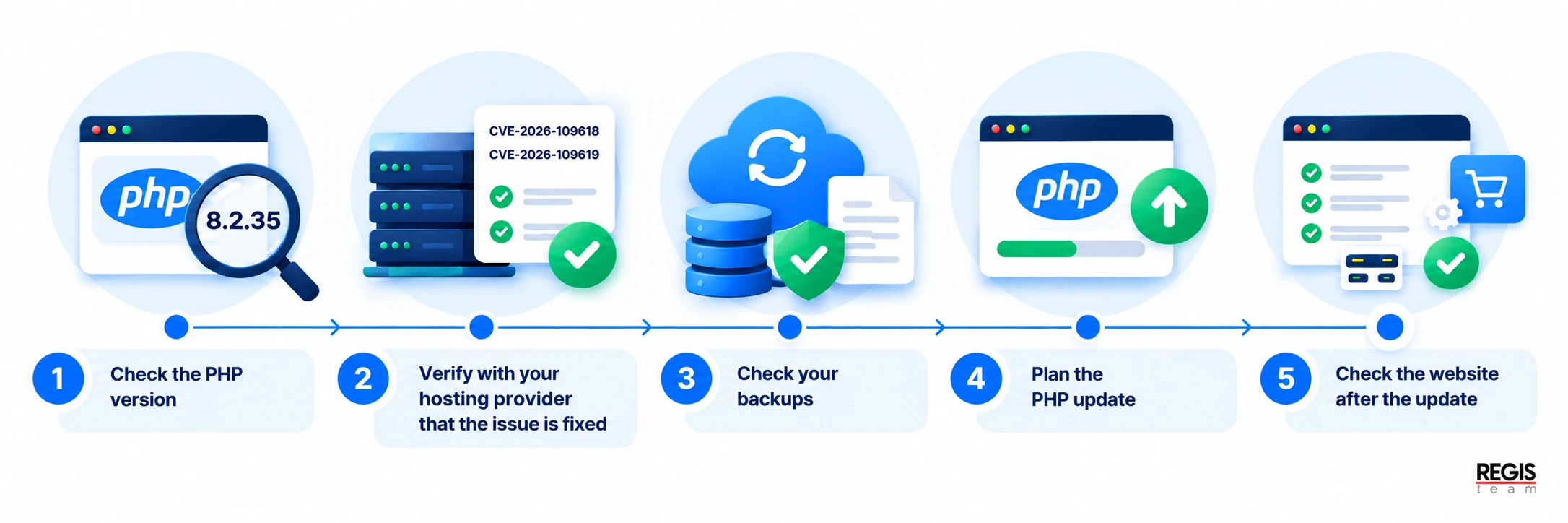
Start with a few basic security checks.

Step 1: Check your PHP version. You can usually find this information in your hosting control panel or ask your server administrator. For WordPress websites, the PHP version is available in the “Site Health” section.

Step 2: Confirm the security patch status with your hosting provider. Ask them to verify whether patches for CVE-2026-109618 and CVE-2026-109619 have been installed.

Step 3: Check your backups. Before updating, make sure you have recent backups of your website files, databases, and configuration files, and that they can be successfully restored.

Step 4: Schedule a PHP update. Installing a patched PHP version or the appropriate security updates is the primary way to address PHP2Shell vulnerabilities.

Step 5: Test your website after updating. Pay particular attention to forms, shopping carts, payment processing, CRM integrations, and other business-critical features.

If your website was running a vulnerable PHP version after October 17, 2026 (when Amazon reported detecting the first attacks), it’s worth checking for signs of unauthorized access or malicious activity, even if the security patches have already been installed.

What You'll Receive After the Express Audit

– An assessment of your PHP environment and any critical security risks.

– A list of identified issues with recommendations for resolving them.

– A clear understanding of whether urgent updates or additional security checks are needed.

– A prioritized technical action plan.

– A preliminary estimate of the cost and timeframe for resolving the identified issues.

An express audit does not replace a comprehensive cybersecurity incident investigation. If signs of a security breach are detected, our technical specialists will recommend the next steps and provide a separate assessment of the work required.

Check Your Website's Security Before an Issue Affects Your Business

Not sure whether your website is running a vulnerable version of PHP? Unsure if the necessary security updates have been installed?

Contact RegisTeam to request an express technical website audit.

We’ll help you assess your current security risks, identify the necessary steps, and estimate the cost of resolving any issues we find.

Why Updating PHP May Not Be Enough

At first glance, the solution seems simple: update PHP and carry on as usual. In practice, however, there are two separate tasks:

The first is to fix the vulnerability. The second is to make sure it hasn’t already been exploited.

Updating PHP closes the known attack vectors associated with PHP2Shell, but it doesn’t automatically remove malicious files, suspicious user accounts, or other changes that may have been left behind after a previous breach. In addition, updating the server environment can cause compatibility issues with older modules, custom integrations, payment systems, and CMS platforms.

That’s why, for commercial websites, it’s important not only to install the security patches but also to assess the overall security of the server environment and thoroughly test the website’s functionality.

RegisTeam Express Technical Website Audit: Identify Security Risks and Assess the Work Required

The widespread shutdowns of government and commercial websites across Europe have shown that even major organizations cannot always address critical security risks immediately. For small and medium-sized businesses, the situation can be even more challenging.

Website owners often don’t know which PHP version their server is running, who’s responsible for keeping it updated, or whether there are signs that their website may have been compromised.

To help businesses address these concerns, RegisTeam offers an express technical website audit.

This is a targeted initial assessment designed to quickly evaluate your website’s security, identify priority risks, and determine what technical work may be needed.

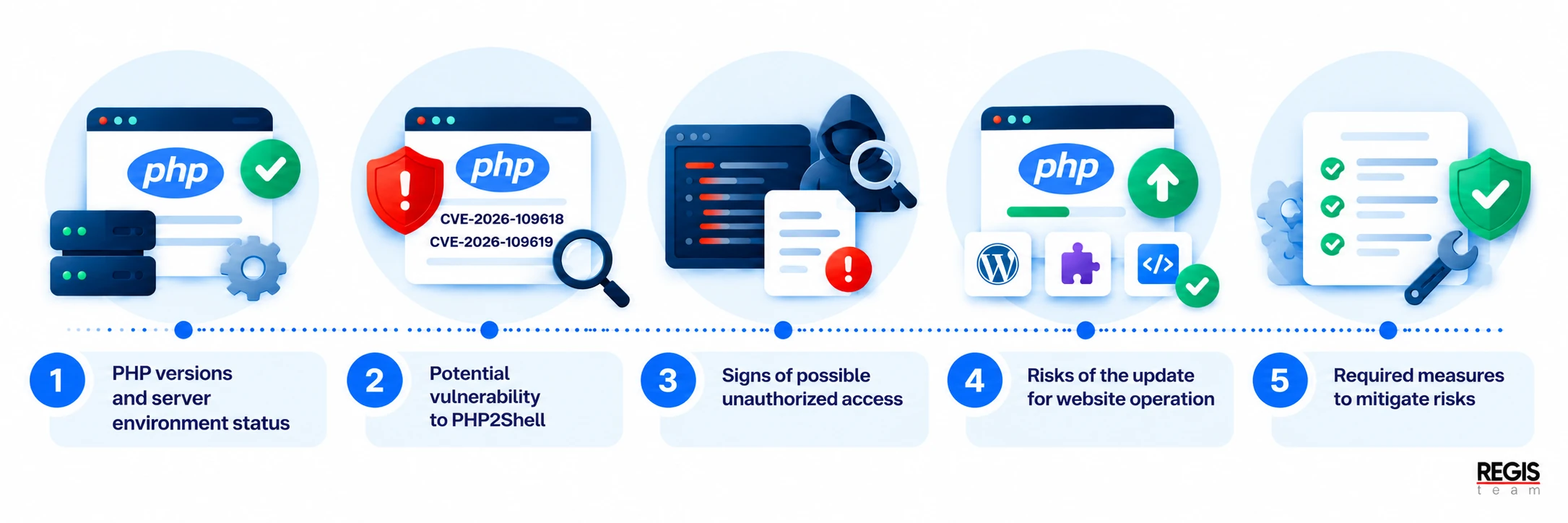
What RegisTeam's Technical Specialists Will Check

1. PHP Versions and Server Environment Status

We’ll check the installed PHP versions, server configuration, and whether the necessary security updates have been applied.

2. Potential Exposure to PHP2Shell

We’ll assess whether your PHP environment may be vulnerable to CVE-2026-109618 and CVE-2026-109619.

3. Signs of Possible Unauthorized Access

With the necessary access permissions, we’ll review available server logs and other indicators that could point to suspicious activity.

4. Potential Compatibility Issues After Updating PHP

We’ll assess possible compatibility issues between PHP, your CMS, plugins, and critical business integrations.

5. Steps Needed to Address Identified Risks

We’ll identify priority actions and provide recommendations for resolving any issues found.

What You'll Receive After the Express Audit

– An assessment of your PHP environment and any critical security risks.

– A list of identified issues with recommendations for resolving them.

– A clear understanding of whether urgent updates or additional security checks are needed.

– A prioritized technical action plan.

– A preliminary estimate of the cost and timeframe for resolving the identified issues.

An express audit does not replace a comprehensive cybersecurity incident investigation. If signs of a security breach are detected, our technical specialists will recommend the next steps and provide a separate assessment of the work required.

Check Your Website's Security Before an Issue Affects Your Business

Not sure whether your website is running a vulnerable version of PHP? Unsure if the necessary security updates have been installed?

Contact RegisTeam to request an express technical website audit.

We’ll help you assess your current security risks, identify the necessary steps, and estimate the cost of resolving any issues we find.

Conclusion: Better to Check Today Than Recover Tomorrow

The PHP2Shell incident has shown just how much modern businesses depend on the security of core web technologies.

Critical vulnerabilities forced government agencies, media companies, banks, and technology organizations to temporarily restrict access to some of their online services.

However, not all of these shutdowns were caused by actual cyberattacks. Many organizations deliberately chose short-term service disruptions to avoid potentially far more serious consequences.

For commercial website owners, the takeaway is simple: technical security should be part of regular website maintenance, not something you only think about after an incident.

If your website uses PHP, make sure the necessary security patches are installed, critical features are working properly, and any signs of potential unauthorized access have been investigated.

And if you’re unsure about your website’s security, start with an express technical audit. It can help you move beyond guesswork, understand the actual risks, and develop a clear plan of action.

Request an Express Technical Website Audit!

Frequently Asked Questions About PHP2Shell

Does PHP2Shell Pose a Risk to WordPress Websites?

Yes, if the server is running a vulnerable version of PHP without the necessary security patches. Updating WordPress does not replace the need to update PHP on the server.

Can PHP2Shell Affect OpenCart and WooCommerce Websites?

Yes. Both platforms use PHP. However, the level of risk depends on the specific server environment and whether the necessary security patches have been installed.

Does Using an Outdated PHP Version Mean Your Website Has Already Been Hacked?

No. Having a vulnerability doesn’t necessarily mean it has been exploited. A technical assessment is needed to determine whether the website has been compromised.

Is Updating PHP Enough to Protect Your Website?

Updating PHP fixes known PHP2Shell vulnerabilities. However, if attackers have already gained access to the server, additional checks and recovery measures may be necessary.

Does Cloudflare Protect Against PHP2Shell?

Cloudflare’s WAF and other security features can help reduce the risk of certain attacks, but they don’t replace the need to install PHP security patches.

What Is an Express Website Security Audit?

This is a targeted initial assessment of the server environment, security update status, and potential risks. It helps identify issues that need attention and determine what further technical work may be required.

How Much Does It Cost to Fix the PHP2Shell Vulnerability?

The cost depends on the condition of the server environment, the website’s complexity, the number of integrations, and the audit findings. After the express audit, RegisTeam specialists can assess the scope of work required and provide a cost estimate.