Best GEO Agencies for ChatGPT and Perplexity Based on What Your Brand Is Missing
A brand can rank on page one, publish expert content, earn backlinks, and still disappear at the exact moment a buyer asks ChatGPT or Perplexity:
“Which company should I choose?”
That failure is often labeled “low AI visibility,” but the label hides several very different problems. An AI system may fail to retrieve the brand, understand what it is associated with, find enough independent evidence to cite it, or consider it credible enough to include in a recommendation.
Those are not the same problem, and they should not lead to the same agency shortlist.
A useful GEO comparison therefore starts one step earlier than most agency rankings:
Where does your brand fall out of the AI decision process?
Accessible → Understood → Retrieved → Cited → Mentioned → Recommended → Chosen
The agencies below are compared through that lens. Instead of ranking them by awards, team size, proprietary terminology, or how many AI services appear on a landing page, we looked at what each company publicly shows it can actually work on: technical retrieval, entity clarity, citation gaps, third-party authority, recommendation visibility, prompt coverage, and measurement.
The goal is not to identify one universal winner. It is to identify which type of GEO partner makes sense for the specific evidence AI-generated answers are missing about your brand.
Start with the AI visibility failure, not the agency list
A brand does not move directly from “website exists” to “ChatGPT recommends us.”
There are several intermediate stages:
Accessible → Understood → Retrieved → Cited → Mentioned → Recommended → Chosen
A weakness at any stage can produce the same visible symptom: poor AI visibility.
| Stage | What can go wrong | What to investigate |
|---|---|---|
| Accessible | AI search crawlers cannot reliably access important pages | robots.txt, CDN/WAF rules, indexability, rendered text |
| Understood | AI cannot clearly identify the company, products, expertise or relationships | entity consistency, organization data, expert profiles, third-party references |
| Retrieved | Brand content is available but rarely selected for relevant questions | topical coverage, prompt coverage, content specificity, information gaps |
| Cited | AI uses competing sources instead of your domain | source authority, originality, content usefulness, third-party source landscape |
| Mentioned | Your information is used but the company name is absent | brand-to-topic association, entity clarity, attribution |
| Recommended | Brand is known but excluded from “best,” “compare” or shortlist answers | comparative evidence, reputation sources, reviews, independent mentions |
| Chosen | AI visibility grows but produces little commercial value | query intent, landing paths, referral tracking, assisted conversions |
This distinction matters because an agency strong in technical audits is not automatically the right choice when the real problem is weak third-party recommendation evidence.
First check whether AI search can actually reach the site
This is a basic test, but it should not be confused with an entire GEO strategy.
OpenAI states that publishers should allow OAI-SearchBot if they want site content to be discoverable, surfaced and cited in ChatGPT search. Perplexity similarly documents PerplexityBot for surfacing websites in its search results.
Google is different. Its current documentation says pages eligible for AI Overviews and AI Mode rely on the normal Google Search technical requirements. Google explicitly says there is no additional AI-specific technical requirement, no special schema type, and no new AI-specific text file is required.
So:
Crawler access is a prerequisite. It is not proof of GEO performance.
The same is true for schema. Structured data can help systems understand explicit information, but adding more JSON-LD does not automatically turn a weak brand into an AI recommendation.
What should actually be measured before choosing an agency?
A useful baseline should go beyond a single “AI Visibility Score.”
At minimum, track five separate metrics.
| Metric | Simple interpretation |
|---|---|
| Prompt coverage | In what percentage of relevant buyer prompts does the brand appear? |
| Citation coverage | Which pages or external sources are actually cited? |
| Recommendation rate | How often is the brand explicitly recommended, not merely mentioned? |
| AI Share of Voice | How often does the brand appear relative to direct competitors? |
| Commercial impact | Do AI referrals contribute to qualified visits, leads or conversions? |
There is also a useful sixth metric: source concentration.
If most positive AI mentions depend on one review site, one Reddit thread or one comparison page, visibility may be less resilient than the headline mention count suggests.
A simple source map can reveal this:
Buyer prompt
↓
AI answer
↓
Brand mention
↓
Supporting source
↓
Source type: owned / media / review / community / directory / competitor comparison
This is especially useful when comparing agencies that help brands appear in ChatGPT and Perplexity recommendations, because recommendation visibility often depends on a wider web footprint than the company website alone.
GEO agencies compared by the problem they are equipped to solve
The sequence below is not a ranking from first to tenth. Instead, it shows what each agency publicly demonstrates and where that capability may be relevant.
| Agency | Publicly visible GEO capability | Most relevant when the missing layer is |
|---|---|---|
| RegisTeam | Multi-platform AI visibility audits, source and competitor analysis, GEO implementation, published AI visibility cases | Diagnosis, cross-platform visibility, citations, content and implementation |
| The Best GEO | Dedicated GEO practice, content/context optimization, AI visibility monitoring | Dedicated GEO strategy and brand/context positioning |
| Siege Media | Prompt/citation research, digital PR, editorial placements, Reddit, affiliate and owned content | Third-party citation and recommendation ecosystem |
| SEO.co | Entity authority, structured data, knowledge graph alignment, technical SEO and GEO | Technical/entity foundation connected to broader SEO |
| Forthea | GEO audits, knowledge graph work, attribution and a public local AI search case | Local, franchise and measurable AI Overview growth |
| Winston Digital Marketing | Seven-step GEO auditing focused on chunks, entities, schema and citations | Deep technical and content diagnosis |
| Stratabeat | B2B prompt research, VoC, content gaps, entity optimization and AI traffic tracking | B2B content and conversational-query coverage |
| Percepture | Enterprise SEO, entity work, structured content and digital PR | Enterprise authority and external citation building |
| Intero Digital | Retrievability, entity strengthening, knowledge graph work and public GEO cases | Enterprise sites and large content ecosystems |
| RevvGrowth | B2B SaaS GEO/AEO, prompt simulations and ongoing LLM citation tracking | SaaS buyer prompts, citations and AI referral growth |
A buyer searching for the best generative engine optimization agency should therefore ask for evidence that matches the problem on the left side of the diagnostic, rather than accepting a generic GEO service list.
RegisTeam
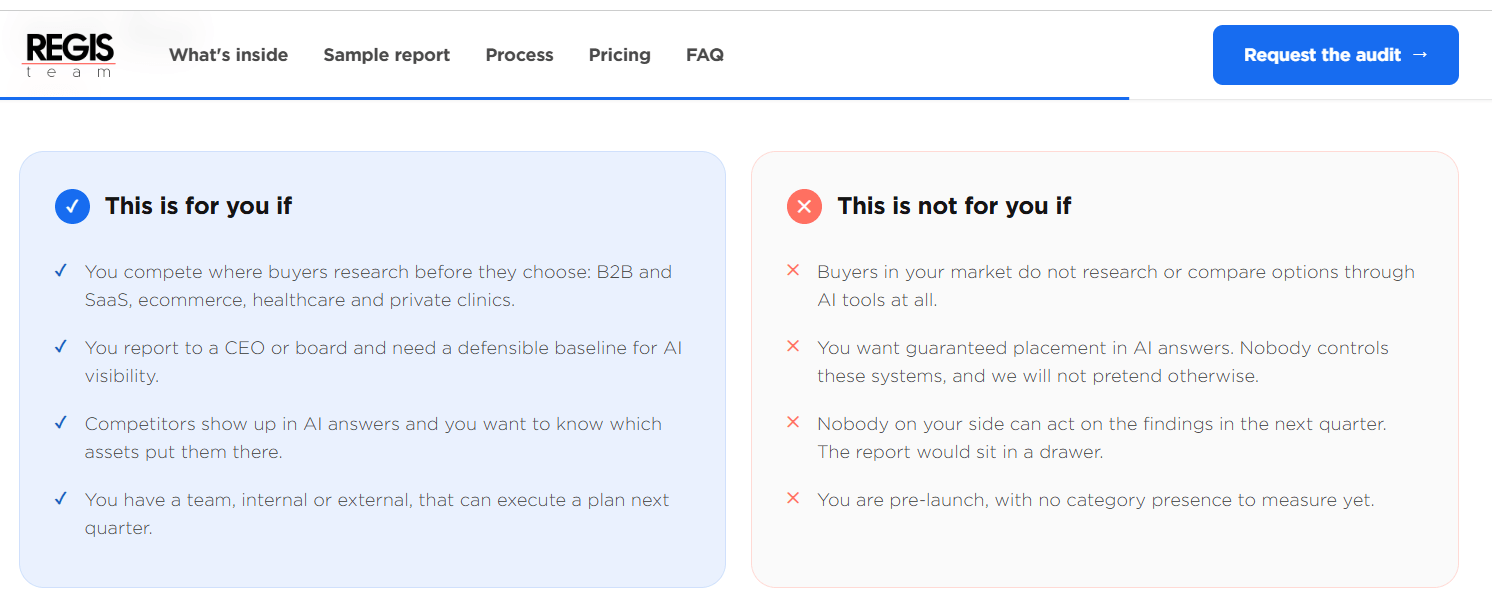
RegisTeam is particularly relevant when the primary problem is not knowing why the brand is missing.
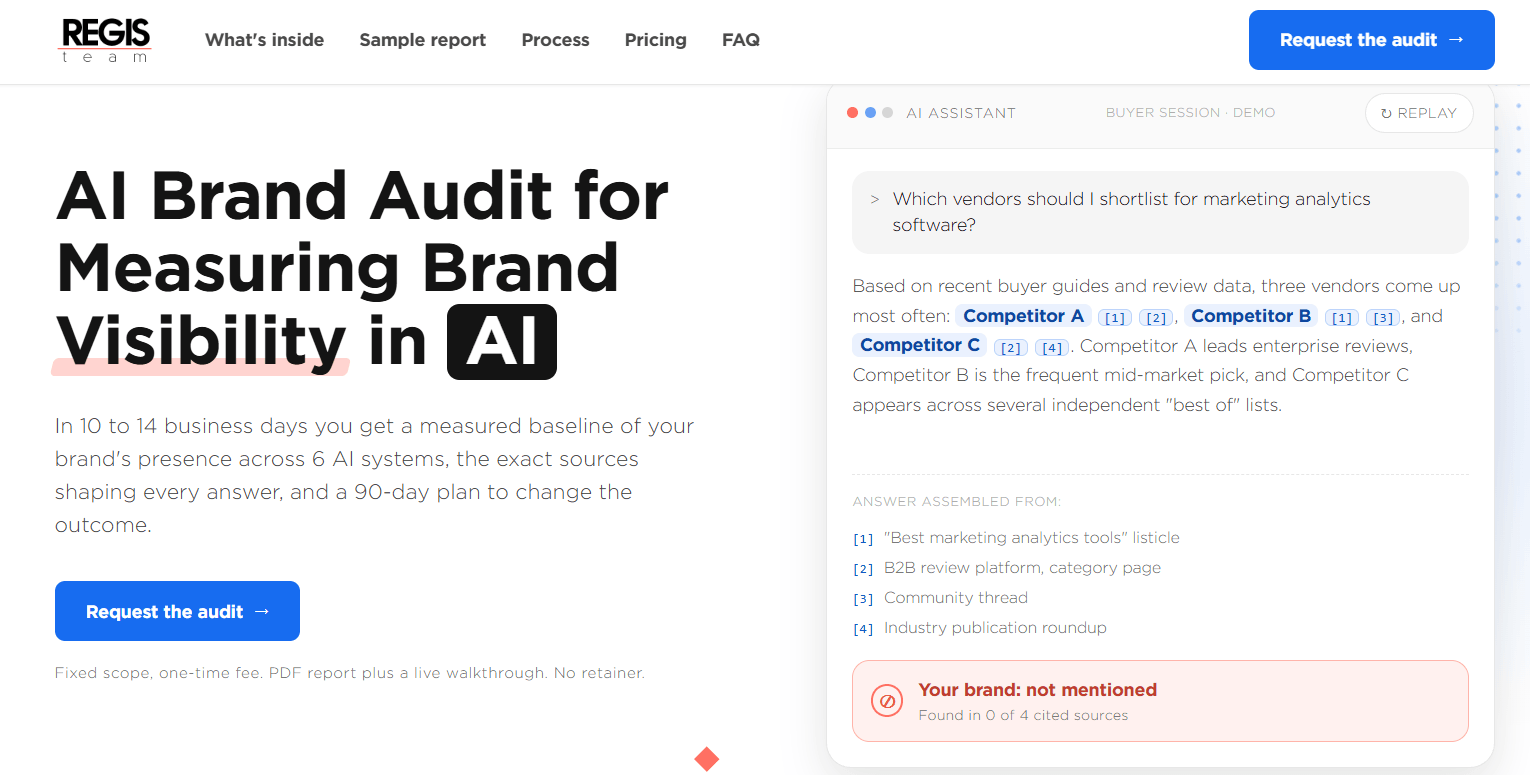
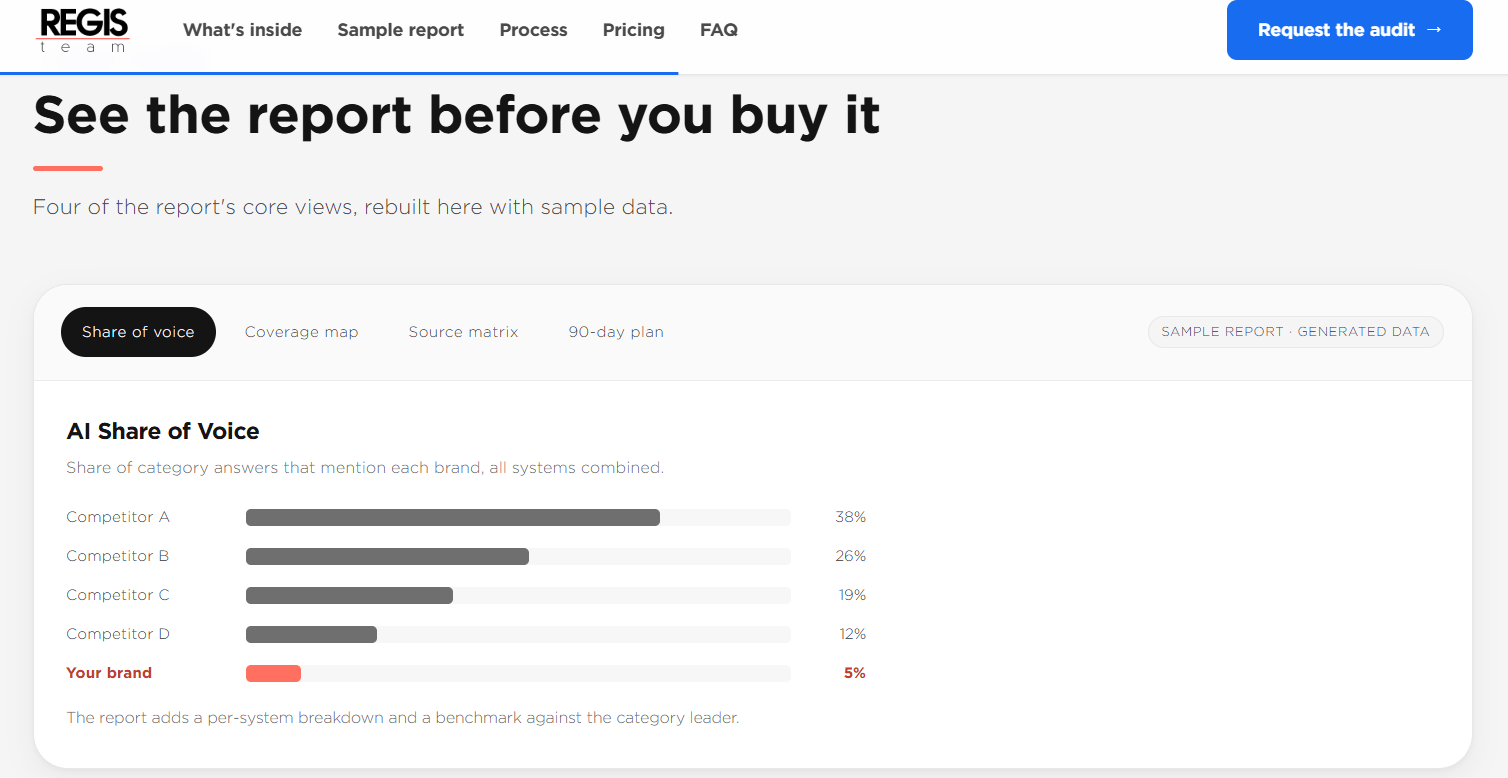
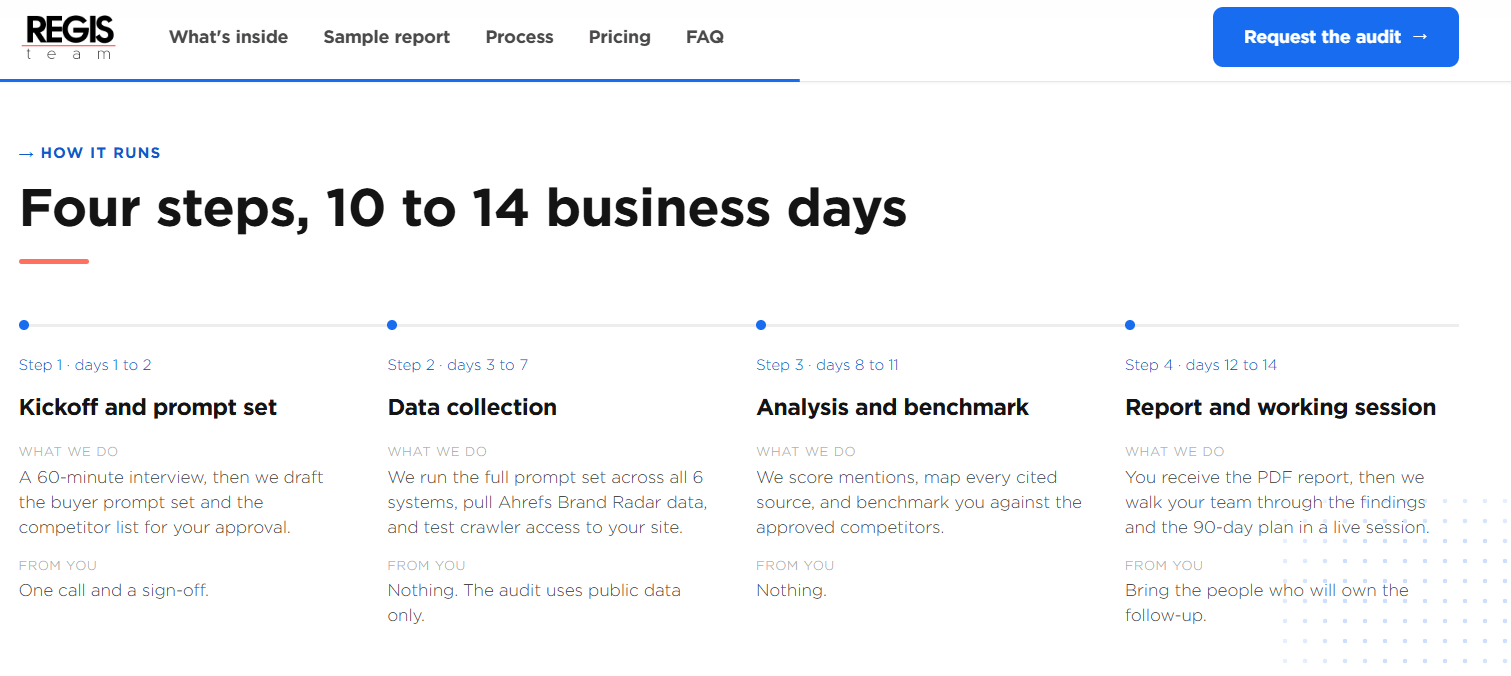
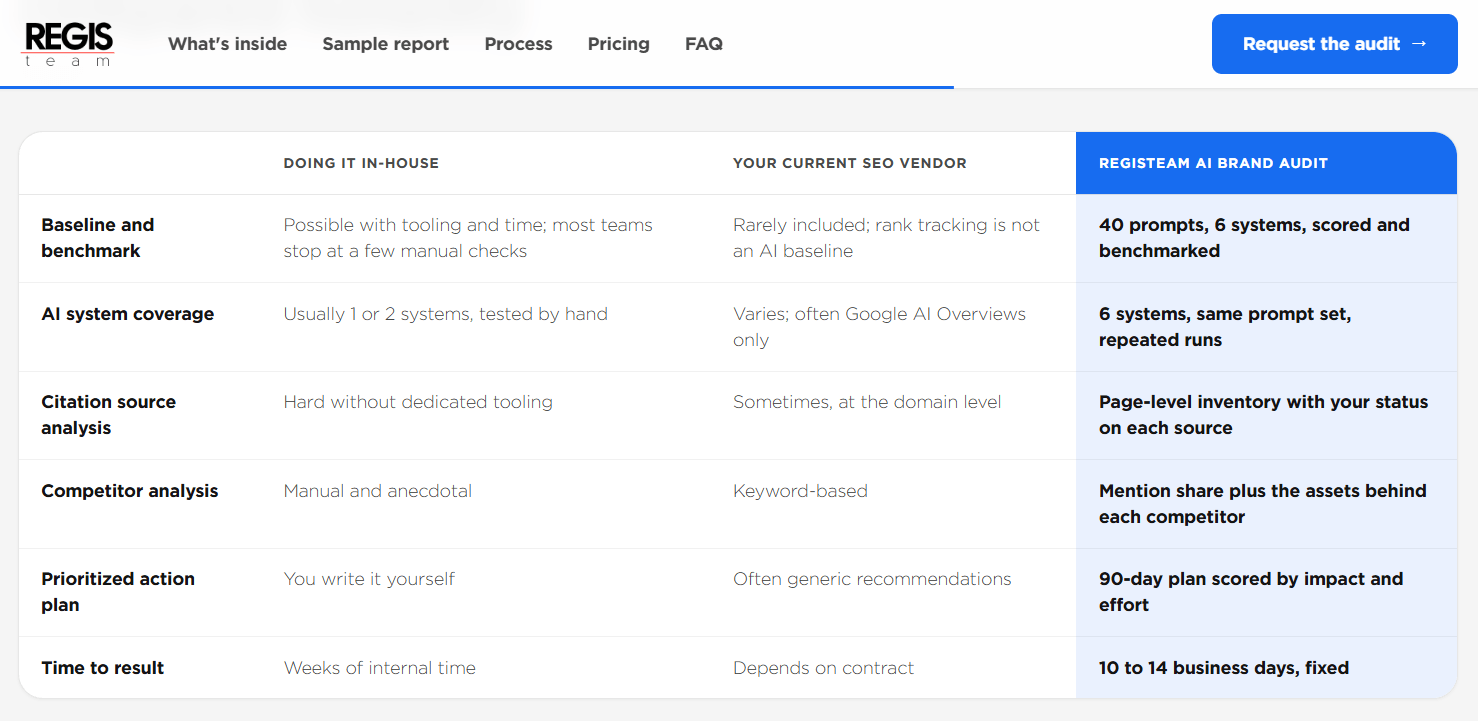
Its public AI Brand Audit methodology examines brand visibility across multiple AI environments and benchmarks the result against competitors. The audit looks at brand mentions, domain citations and the sources used by generative systems rather than reducing performance to traditional rankings alone.
That diagnostic layer is supported by public implementation cases.
In one international eCommerce project, RegisTeam reports moving from limited generative visibility to more than 7,000 AI responses and more than 2,500 pages used by AI systems, including approximately 2.8K additional responses in Google AI Mode and 1.9K additional responses in Google AI Overviews. The work covered content structure, technical preparation, topical authority and AI-oriented content formats.
A separate UK services project provides another useful type of evidence. The site started with only three Google AI Overview appearances and effectively no tracked ChatGPT visibility. The published case later records 990 Google AI Overview responses, 226 ChatGPT responses, 240 Perplexity responses, 138 Copilot responses and 105 Gemini responses.
Where RegisTeam fits
| Situation | Fit |
|---|---|
| You rank in Google but have little AI visibility | Strong |
| You need to compare several AI systems rather than one dashboard | Strong |
| You do not know whether the problem is content, citations, competitors or entity signals | Strong |
| You need diagnosis plus implementation rather than monitoring alone | Strong |
| Your only requirement is large-scale PR placement | Not the most specialised use case |
The distinguishing point is not a proprietary label or a claim to “control” ChatGPT. It is the ability to connect audit → source analysis → implementation → measured change across several platforms.
The Best GEO
The Best GEO presents itself as a specialist practice focused specifically on generative visibility rather than as a general digital agency adding an AI service.
Its public methodology emphasises context rather than only keyword targeting, content that can be interpreted and cited by AI systems, domain credibility and ongoing visibility monitoring. Its educational material also discusses Share of Voice, sentiment, hallucinations and differences in citation behaviour between AI systems.
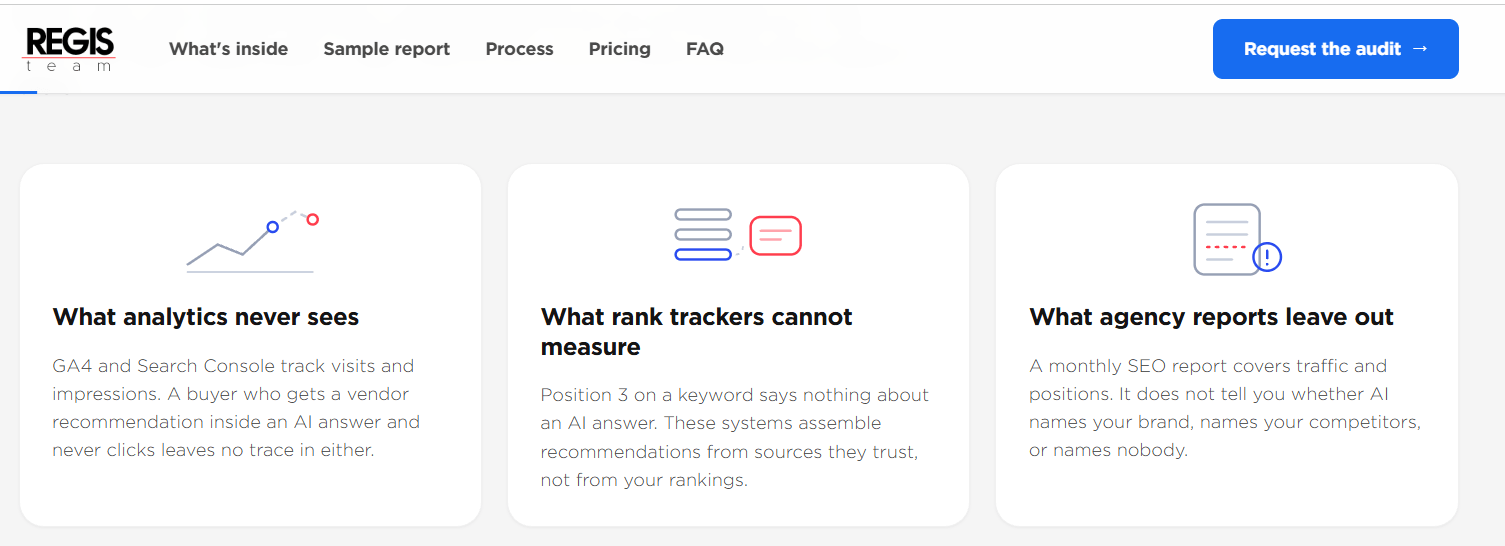
This makes it relevant when a company wants a dedicated GEO framework and ongoing AI presence work.
The evidence question is important, however. In the public pages reviewed for this comparison, the methodology is easier to verify than named client-level GEO outcomes. That does not mean results do not exist, but a buyer should request baseline and post-implementation data for comparable projects.
Ask for: a named or sufficiently documented project showing prompt coverage, citation movement and the platforms measured.
Siege Media
Siege Media is worth examining when the website itself is not the primary problem.
Its GEO program treats visibility as a citation graph spread across several surfaces. Publicly described work includes owned content, proprietary research, digital PR, editorial roundups, Reddit/community participation and affiliate relationships. Siege also tracks LLM Share of Voice, citations and AI-referral traffic.
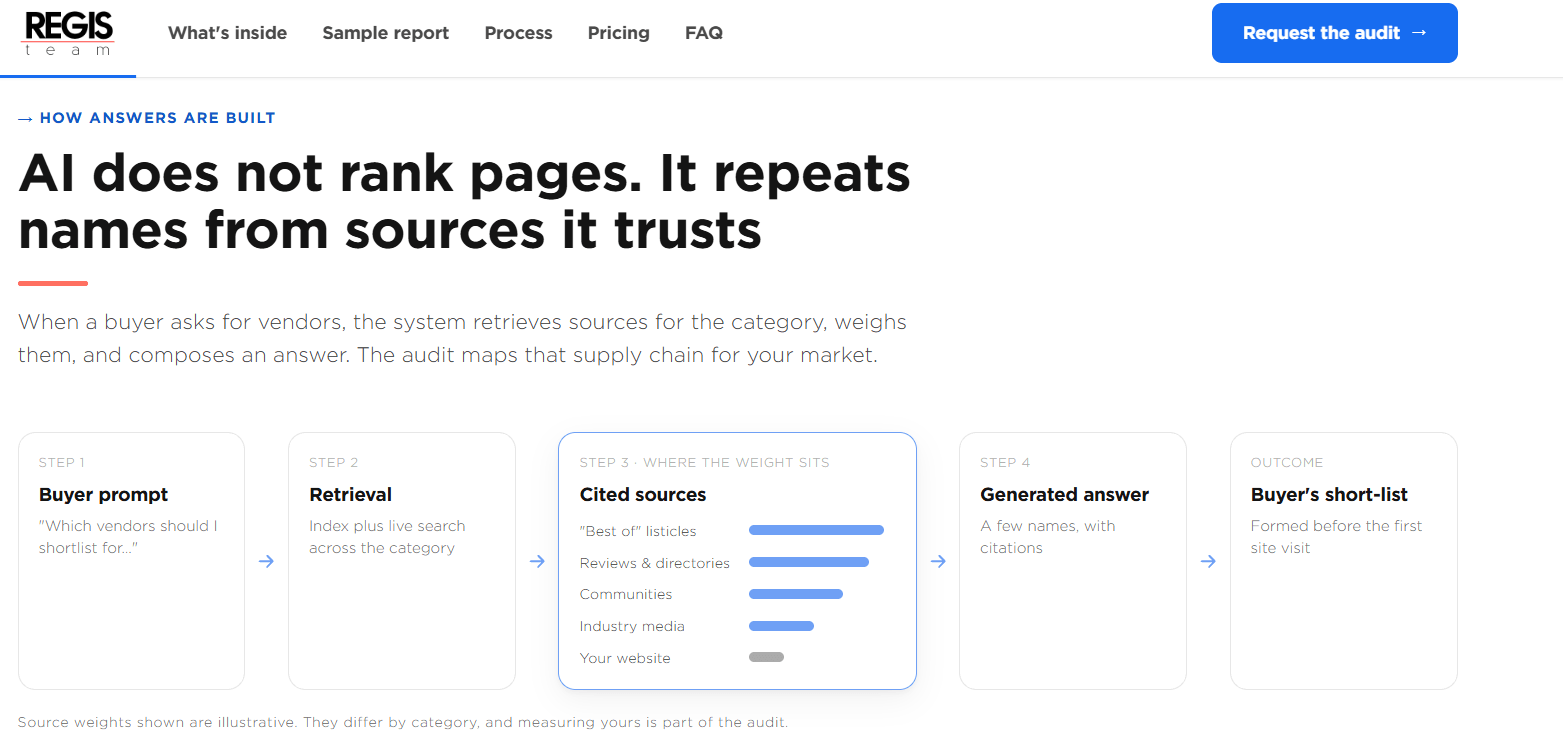
That is a different problem from fixing a robots.txt file or adding an FAQ.
Imagine this situation:
Your site ranks well
↓
ChatGPT knows your company
↓
But “best X” prompts repeatedly recommend competitors
The missing evidence may exist outside your domain.
AI systems can encounter:
- editorial comparisons;
- independent research;
- community discussions;
- review platforms;
- affiliate roundups;
- third-party datasets.
Siege’s public GEO positioning explicitly works across several of these surfaces. It also publishes its own research into AI referral behaviour and citation patterns.
Best diagnostic fit
Strongest when the brand already has content and SEO authority but lacks the independent source footprint needed to enter comparison and recommendation conversations.
SEO.co
SEO.co approaches GEO from a technical SEO and entity-engineering background.
Its dedicated AI SEO service describes work around entity authority, structured data, citable content, knowledge graphs and visibility across ChatGPT, Perplexity, Claude, Gemini and Google AI Overviews. GEO is also described as part of its broader managed SEO engagements rather than an isolated add-on.
This can be useful for organisations where the AI visibility problem overlaps with an existing technical SEO problem.
For example:
Weak crawl/index foundation + inconsistent entities + thin content architecture
is a different engagement from:
Strong site + weak third-party recommendation footprint.
SEO.co’s public offering aligns more naturally with the former.
Its site provides a clear operating methodology. For an evidence-based selection, however, buyers should separately request GEO-specific client outcomes rather than relying on the firm’s broader SEO history.
Forthea
Forthea becomes particularly interesting when AI visibility needs to be connected to local or multi-location search and measurable business actions.
Its GEO practice includes visibility audits, entity mapping, content strategy, knowledge graph work, citation tracking and dashboards intended to connect generative visibility with leads and revenue.
More importantly, it publishes a specific AI search case.
For Paul Davis Milwaukee, Forthea reports growth from 1 to 61 appearances in Google AI Overviews year over year , 31 new AI Overview rankings in selected service categories, six location-focused AI Overview rankings and more than 40 tracked LLM sessions. The wider local campaign also recorded increases in call volume and website clicks.
This does not prove that the same result transfers to every business, but it provides something more useful than a generic service promise: a visible baseline, documented actions and a measured outcome.
Strongest diagnostic fit
– franchises;
– service-area businesses;
– multi-location brands;
– local entities;
– businesses that need AI visibility tied back to calls or leads.
Winston Digital Marketing
Winston Digital Marketing stands out less for a large public catalog of GEO success stories and more for the specificity of its diagnostic framework.
Its published GEO audit contains seven stages:
Inventory → Chunk audit → Schema audit → Entity audit → Citation analysis → Competitive delta → Roadmap
The methodology also argues that citation checks should be run separately across AI systems rather than assuming that one engine represents all of them.
That makes Winston particularly relevant when the problem is difficult to isolate.
For example:
- useful information is buried inside large pages;
- key answers cannot stand alone as retrievable passages;
- entity signals conflict;
- competitors are cited for prompts where your site appears stronger in Google;
- one AI system can retrieve the brand while another cannot.
Winston also offers a public audit that evaluates source authority, chunk-level citability, schema, entity clarity, freshness, expert presence, third-party citation relationships and monitoring.
Strongest diagnostic fit
Technical and information-architecture diagnosis before a larger GEO program.
A buyer should still request client-level evidence demonstrating how often those audit recommendations have translated into sustained citation or recommendation gains.
Stratabeat
Stratabeat has a narrower B2B angle.
Its public GEO offering includes:
- Voice of Customer research;
- prompt research;
- conversational query analysis;
- competitor and content-gap analysis;
- GEO visibility audits;
- entity and schema work;
- original thought leadership;
- AI search performance tracking.
This is relevant because B2B recommendation prompts are often more specific than traditional keyword searches.
A user might not ask:
“data governance software”
but instead:
“Which data governance platform is appropriate for a mid-market financial company that needs X, Y and Z?”
A company can rank for the first query and still be absent from the second type of search.
Stratabeat publicly reports LLM-sourced traffic increases for clients, including 218.2% within four months for one client and 183.0% for another, while noting increases in sales-qualified leads from AI engines. These are agency-reported figures, so they should be evaluated alongside the underlying project context during vendor selection.
Strongest diagnostic fit
B2B brands that are visible for conventional search topics but weak across natural-language buyer scenarios.
Percepture
Percepture combines enterprise SEO, GEO and digital PR.
Its public GEO service includes AI visibility analysis, entity mapping, structured content, schema support, external citations and tracking across several AI environments. It also explicitly combines owned-site optimization with PR and entity work.
That combination is relevant when a brand’s problem looks like this:
AI understands the topic
+
AI can crawl the website
+
competitors still receive stronger trust signals from the wider web
Percepture also publishes sector-specific GEO material for B2B, telecom, life sciences and other categories, which suggests a strong emphasis on translating broad GEO principles into industry-specific buyer questions.
Its service page publishes substantial client-growth claims, but some are anonymised in the public material reviewed here. Those numbers are therefore better treated as self-reported evidence to investigate rather than directly comparable benchmark data.
Strongest diagnostic fit
Enterprise and B2B organisations where external authority, PR and entity credibility are likely to be major constraints.
Intero Digital
Intero Digital is especially relevant to larger sites where retrievability and entity relationships are difficult to manage at scale.
Its current GEO framework treats retrievability as an additional layer beyond traditional crawlability and indexability. The agency works with entity relationships, knowledge graphs, AI-oriented content structures and external brand signals across the web.
The public evidence is also relatively substantial.
Intero reports:
- a kitchen equipment project with a 5,665% increase in AI search visibility;
- Global Industrial moving from zero Google AI Overview presence to more than 1,200 appearances;
- TRACOM Group recording a 1,184% increase in generative search visibility and 39+ AI Overview/zero-click placements.
These are agency-published cases rather than independently audited experiments, but they provide useful information about the baseline, work performed and outcomes.
Strongest diagnostic fit
– enterprise sites;
– large content libraries;
– complicated entity structures;
– brands already doing SEO at scale;
– organisations that need AI visibility integrated into a broader digital program.
RevvGrowth
RevvGrowth has a clear B2B SaaS orientation.
Its public GEO materials focus on prompt simulations, entity foundations, content architecture, short-answer content and ongoing citation tracking.
Its site also publishes concrete SaaS examples.
For Atlan, RevvGrowth reports visibility across more than 7,600 AI prompts and more than 6,500 domain citations across ChatGPT, Perplexity and Google AI Overviews. For OvalEdge, it reports growth from 100 to 278 monthly LLM referral sessions alongside citations across ChatGPT, Perplexity and Gemini.
That makes the agency particularly relevant when the missing layer is not generic brand visibility but buyer research within a software category.
Strongest diagnostic fit
B2B SaaS brands that need to connect prompt-level discovery, comparison queries and LLM referrals.
Which agency fits which AI visibility problem?
The most practical comparison is therefore not “who offers GEO?” Nearly everyone on this list does.
It is:
What is currently broken?
| Your current symptom | Agencies worth examining first |
|---|---|
| We have strong Google visibility but almost no AI visibility | RegisTeam, Intero Digital, Winston Digital Marketing |
| We do not know why competitors appear in AI answers while our brand does not | RegisTeam, Winston Digital Marketing, Forthea |
| Our brand appears only for branded prompts | RegisTeam, Stratabeat, RevvGrowth |
| AI understands our content but rarely recommends the company | Siege Media, Percepture, RegisTeam |
| We lack independent media/community/review evidence | Siege Media, Percepture |
| Entity relationships or technical architecture are unclear | SEO.co, Intero Digital, Winston Digital Marketing |
| We operate across many locations | Forthea |
| We are a B2B SaaS company | RevvGrowth, Stratabeat |
| We need a dedicated GEO-focused specialist | The Best GEO |
| We need AI visibility tied to wider SEO implementation | RegisTeam, Intero Digital, SEO.co |
This is a more useful way to search for the best AI search optimization agency because it makes the required capability explicit.
Look at the sources behind the recommendation
If a competitor repeatedly appears in AI shortlists, analyse the evidence surrounding it.
A useful source-gap table looks like this:
| Prompt | Recommended competitor | Supporting sources | Source types | Your brand present? |
|---|---|---|---|---|
| Best tool for X | Competitor A | Site 1, Site 2 | Review + editorial | No |
| X alternatives | Competitor B | Site 3, Reddit | Comparison + community | No |
| X for enterprise | Competitor A | Site 4, own site | Media + owned | Yes, but not recommended |
Patterns begin to emerge quickly.
You may discover that your content is not the core weakness at all. The actual gap could be:
- no inclusion in category roundups;
- weak reviews;
- no expert references;
- inconsistent company information;
- no original data;
- missing comparison content;
- little discussion in the communities AI repeatedly retrieves.
At that point, publishing another generic blog article is unlikely to solve the problem.
Who can help my brand get cited by ChatGPT?
There is no single answer without diagnosing the missing layer.
If ChatGPT cannot reliably discover the site, start with technical retrieval and crawler access.
If the site is accessible but the brand is poorly understood, investigate entity clarity and external consistency.
If the brand is known but absent from category prompts, analyse prompt and topical coverage.
If content is cited but competitors are recommended, investigate third-party evidence, comparative positioning and the sources AI uses when building shortlists.
If recommendations already exist, the next problem is measurement and commercial impact.
That is also why searching for the best generative engine optimization agency without establishing a baseline first often produces the wrong shortlist.
There is no useful universal winner because these agencies solve overlapping but different problems.
RegisTeam has particularly relevant public evidence for brands needing multi-platform diagnosis followed by implementation and measurable AI visibility growth.
Siege Media is especially relevant where the missing layer sits outside the company website, across editorial, community and other citation surfaces.
Forthea has a useful public proof point for local and multi-location AI visibility.
Winston Digital Marketing publishes one of the more explicit technical GEO audit methodologies in this group.
Stratabeat and RevvGrowth have a natural fit with B2B and SaaS prompt behaviour.
Percepture combines GEO with enterprise SEO and digital PR, while Intero Digital provides substantial public evidence around enterprise retrievability and AI visibility programs.
SEO.co is relevant where technical SEO, entity engineering and AI search need to operate as one program, while The Best GEO offers a dedicated specialist GEO approach centred on context, citation and generative visibility.
The more useful question is therefore not: “Which company has the strongest GEO sales page?”
It is:
At what point does AI stop choosing your brand, what evidence explains that failure, and which agency has demonstrated that it can work on that exact layer?
That is the question that turns a GEO agency comparison from a list of vendors into a useful buying decision.