Testing ChatGPT Ads for B2B Lead Generation in the U.S.: 1,672 Clicks, 38 Leads, and Key Takeaways
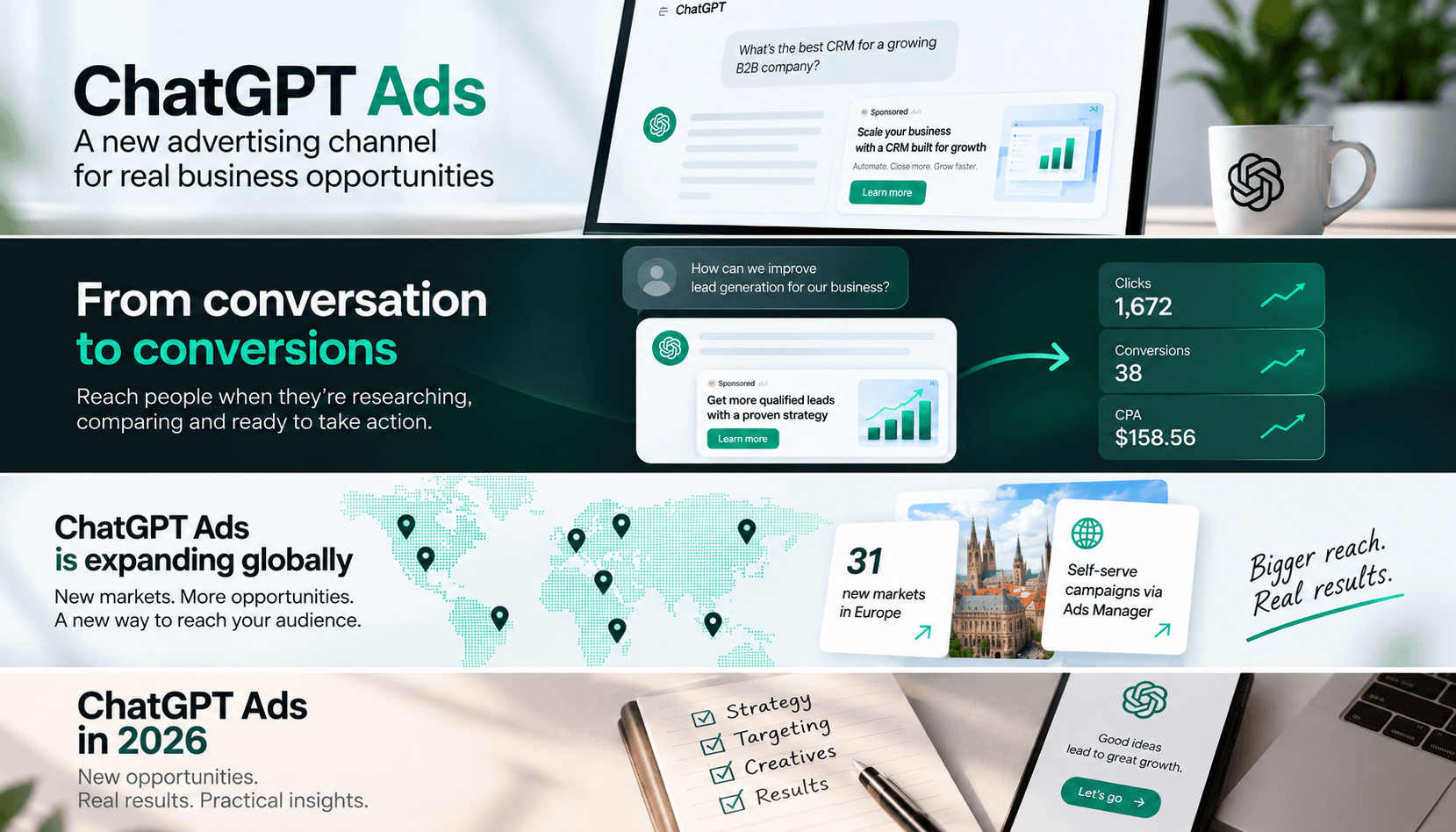
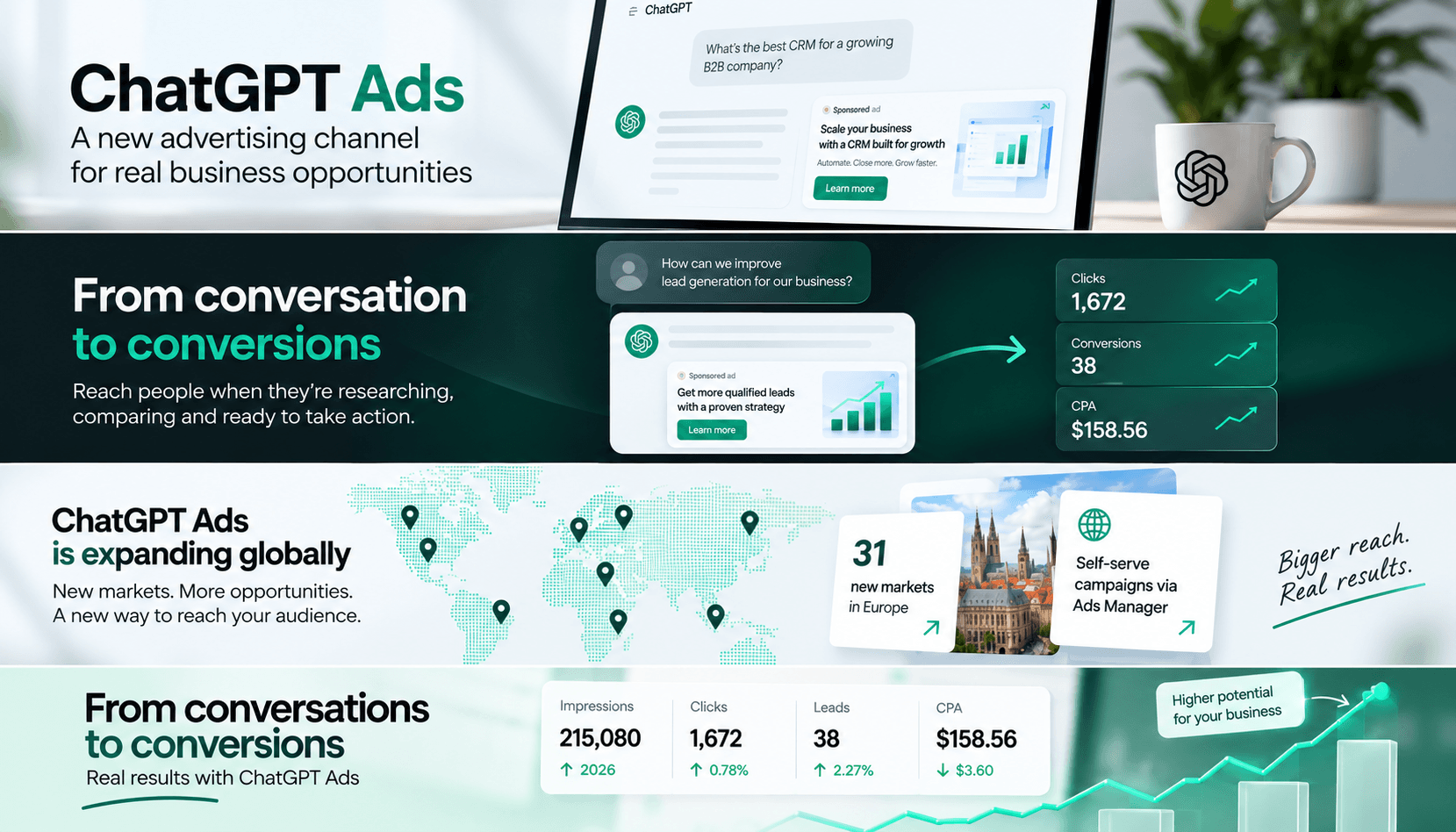
At the beginning of 2026, advertising in ChatGPT was still an experiment. On February 9, OpenAI launched its first test in the U.S., and over the next six months, the program expanded to eight more markets. The biggest step came in August, when ChatGPT Ads rolled out across 31 European markets. Starting August 31, advertisers in those markets were able to launch campaigns independently through Ads Manager.
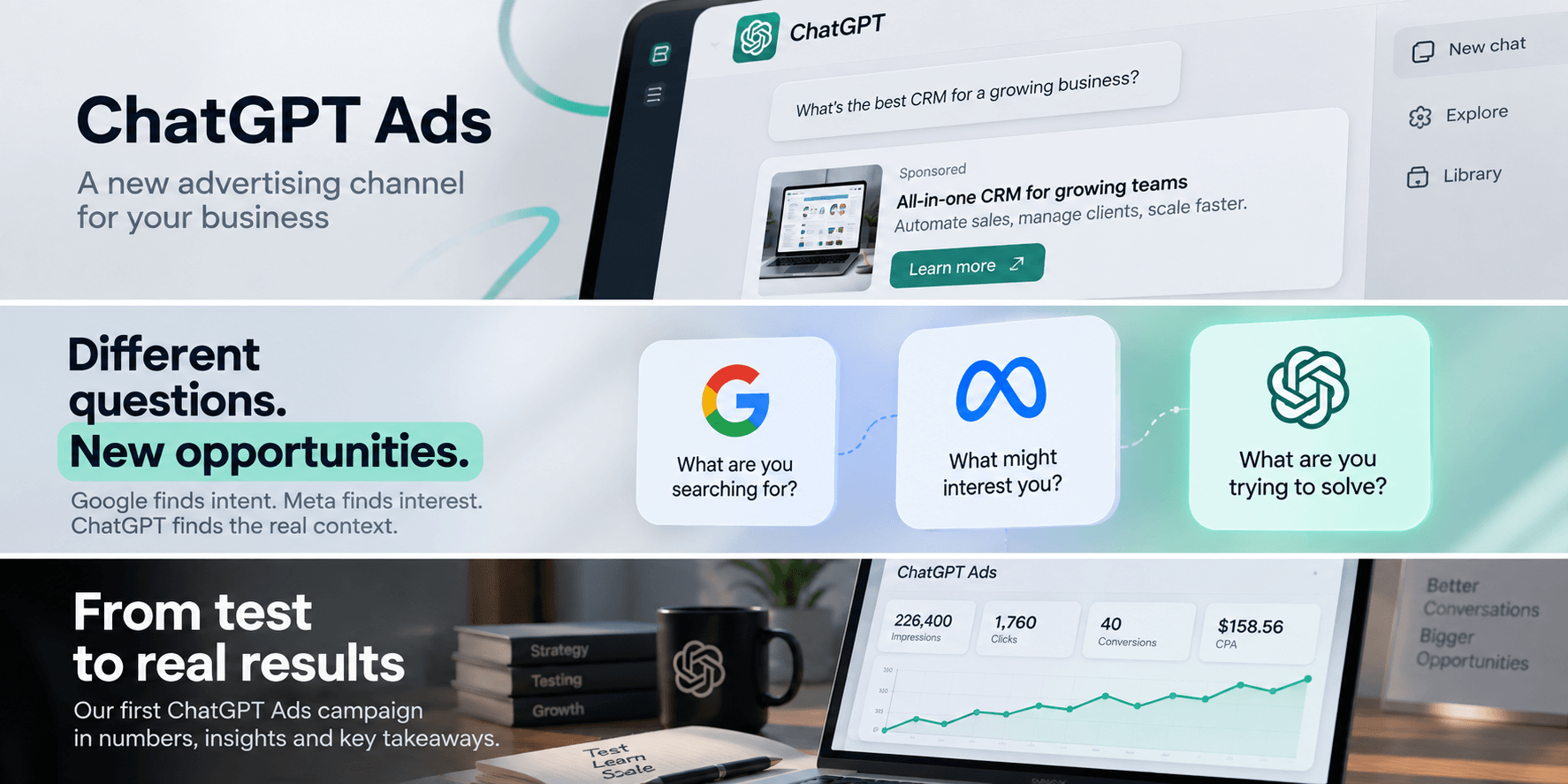
For businesses, this means the emergence of a new advertising channel — with a very different mechanic. An ad can appear directly during a conversation with ChatGPT, when the user is already exploring a topic, comparing options, or looking for a way to solve a specific problem. At the same time, the ad remains separate from the model’s response and does not influence it.
At RegisTeam, we have been working with paid traffic in Google Ads and Meta Ads for more than 15 years. So when a new advertising channel appeared, we decided to test it not just by reading the documentation, but on a real client project.
For the test, we launched ChatGPT Ads for a B2B consulting business in the U.S. We wanted to see how much the traffic would cost, whether the channel could generate leads, and what limitations a PPC specialist would have to work with.
Below, we show the campaign numbers, settings, and takeaways from our first launch.
Results of the first ChatGPT Ads test
Let’s start with the numbers — in this case, they really say a lot.
For the first test, we launched a campaign for a B2B consulting business in the U.S. The goal was very practical: to generate consultation requests from the website and understand whether ChatGPT Ads could work as a performance channel, not just bring in curious users.
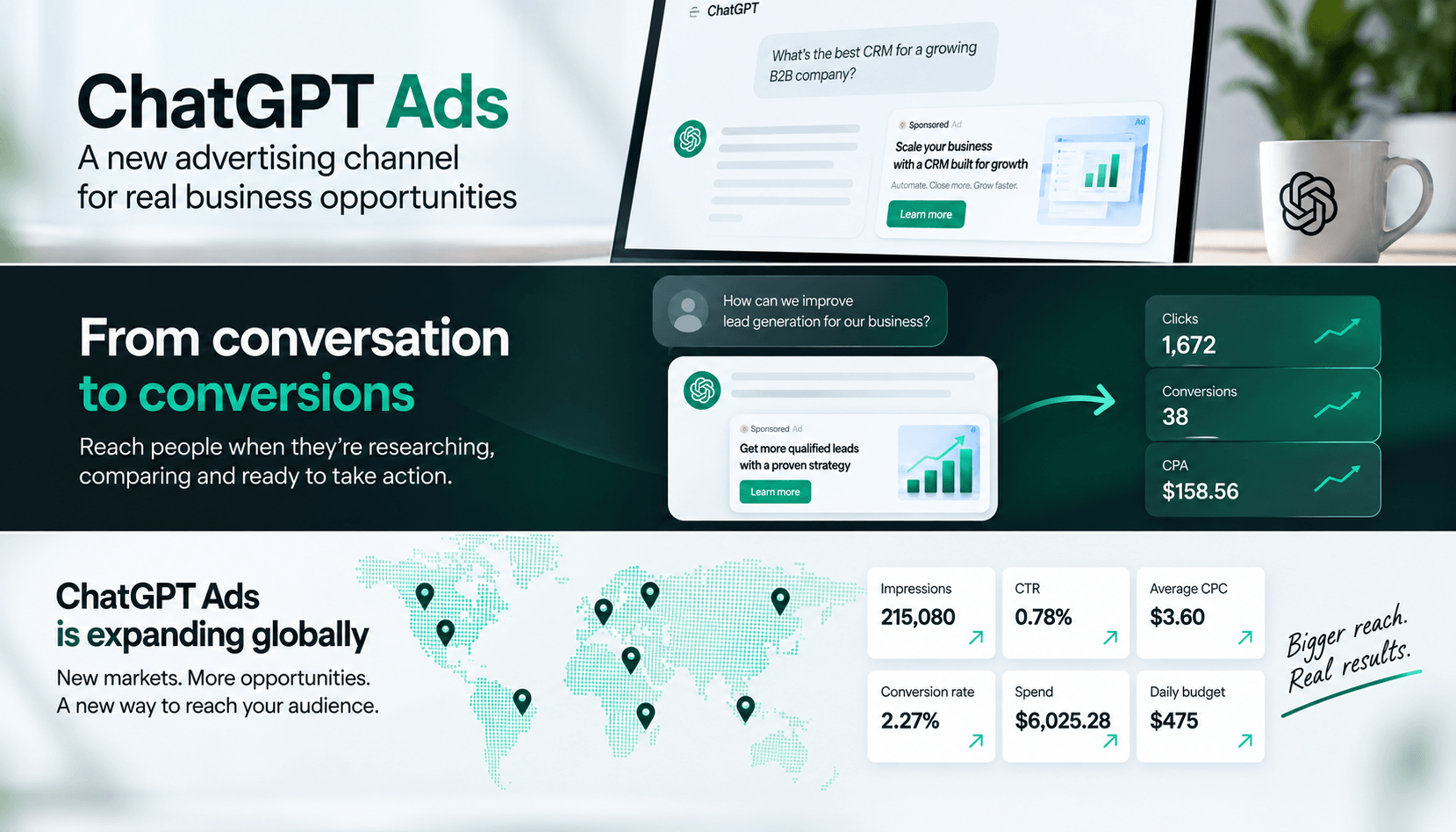
The campaign was launched with a daily budget of $475 and click-based optimization.
| Metric | Result |
|---|---|
| Daily budget | $475 |
| Impressions | 215,080 |
| Clicks | 1,672 |
| CTR | 0.78% |
| Average CPC | $3.60 |
| Conversions / leads | 38 |
| Conversion rate | 2.27% |
| Spend | $6,025.28 |
| CPA | $158.56 |
In the RegisTeam test, ChatGPT Ads for a B2B consulting business in the U.S. generated 38 leads with an average CPC of $3.60 and a CPA of $158.56. The conversion rate was 2.27%. The campaign was optimized for clicks.
For us as a performance marketing team, it was important to evaluate the new ad format using familiar business metrics: cost per click, conversion rate, CPA, and lead quality.
As a result, the campaign generated 38 leads at a CPA of $158.56. For a complex B2B service, this is enough to justify further testing of the channel and take a deeper look at traffic and lead quality.
Why this project was a good test for ChatGPT Ads
We chose B2B consulting for the first launch for a reason. In this niche, a client rarely makes a decision after a single ad interaction. They usually need to understand the service, compare options, clarify details, and decide whether the provider is a good fit for their specific task.
The path to a lead is longer here than in a simple “saw the product — liked it — bought it” scenario. And this is exactly what makes ChatGPT Ads interesting to test: the user may already be discussing their problem with ChatGPT before deciding to contact a specialist.
For us, this made the test especially indicative. If ads can generate leads in a niche where the decision requires research and trust, the channel may also have potential for other complex B2B products and services.
How we set up advertising in ChatGPT
For the first test, we intentionally kept the campaign simple. Before expanding the structure and scaling the budget, we wanted to understand whether the new channel could bring in relevant traffic and generate leads.
1. We launched a campaign focused on website leads
The campaign targeted a B2B audience in the U.S. The main result we cared about was a consultation request submitted through the website.
At the same time, we selected click optimization in Ads Manager. At this first stage, we wanted to see how much traffic the new channel could generate, how much each click would cost, and whether that traffic would convert into leads.
2. We limited impressions to the U.S. market
The campaign geography was the United States — the market where the client provides its services.
This helped us avoid mixing several countries with different traffic costs and user behavior in one test, and gave us a clearer picture for a single market.
3. We built the campaign around one target scenario
We did not split the first test into several directions. Instead, we built the structure around one service and one main action — a consultation request.
The advertising setup included a clear offer, a short service description, a graphic creative, a landing page, and a call to visit the website.
This approach helped us avoid spreading the budget across different scenarios and allowed us to see how ChatGPT Ads performs with one specific B2B offer.
In the next test, we would expand the creative part: add different visual concepts and ad messages to compare CTR, traffic quality, and conversion rates across several variants.
4. We left part of the audience selection to the algorithm
This is where the difference from familiar advertising systems became especially noticeable.
Compared with our usual work in Google Ads and Meta Ads, the difference is clear right away: ChatGPT Ads currently offers far fewer options for manual audience control and impression analysis.
The system considers the context of the conversation and determines how relevant the ad offer is to the user’s current task. For our test, this meant a simple setup: we define the offer and the main campaign parameters, while a significant part of the decision about who sees the ad and in what context is left to the algorithm.
At the same time, Ads Manager does not provide a full report on the exact prompts or conversations where the ad was shown. For a PPC specialist who is used to digging into search queries in detail, this is currently one of the platform’s most noticeable limitations.
What we learned after the first launch
The first test gave us more than just 38 leads. It showed where ChatGPT Ads can already be useful for businesses, and where the platform still noticeably falls behind more mature advertising systems.
1. The channel can generate leads even in a complex B2B niche
This is the main practical takeaway from our test.
The campaign generated 38 conversions at a CPA of $158.56. For a new advertising channel and a B2B service with a long decision-making cycle, this is enough to continue testing and take a deeper look at the quality of the leads.
At the same time, we do not treat this CPA as a market benchmark. For now, it is the result of one specific campaign, not a universal standard for ChatGPT Ads.
2. There is noticeably less manual control
For our PPC team, this is one of the most noticeable differences with ChatGPT Ads: at this stage, there are fewer options for manual audience management and impression analysis than in Google Ads or Meta Ads. In familiar advertising systems, we can analyze queries, audiences, and segments in detail. Here, a significant part of the decision-making is left to the algorithm.
For launch, this simplifies part of the setup. For analysis, it raises more questions.
3. Transparency is still limited
One of the most noticeable limitations was the lack of detailed data on the exact prompts and conversations where the ad was shown.
We can see the main campaign results — impressions, clicks, leads, and cost — but we cannot analyze the user journey in the same level of detail we are used to in search advertising.
For a PPC specialist, this feels quite unusual. Sometimes you just want to open a report, dig into the exact query, and understand what worked. But there is no such report. We’ll survive.
4. In the next test, we would expand the creative part
The first launch allowed us to test the channel itself and collect initial data on traffic and leads. The next step would be to test more ad messages and visual concepts.
We would add several creative variations to compare CTR, traffic quality, and conversion rate, and understand which combinations of message and visual work best.
5. It is too early to draw conclusions about traffic quality
Based on the logic of the format, ChatGPT Ads may work well when the user is already exploring a problem and looking for a solution. But one campaign is not enough to say that this traffic is higher quality than traffic from Google Ads or Meta Ads.
To understand that, we need more data — and, more importantly, we need to look not only at the number of leads, but also at their quality further down the funnel.
That is why, for us, the first launch is a signal to continue testing, not a final conclusion about the effectiveness of ChatGPT Ads.
What you need to know before launching ChatGPT Ads
After the first test, we would highlight a few things worth checking before adding funds to your ad account.
Not all ChatGPT users see ads
Currently, ads can be shown to users on the Free and Go plans. There are no ads on Plus, Pro, Business, Enterprise, or Edu plans. OpenAI also does not show ads to accounts belonging to users under 18.
For B2B, this is an important nuance. Some potential clients — especially active ChatGPT users who use it for work — may be on paid plans and simply fall outside the available advertising audience.
In other words, ChatGPT’s huge user base does not automatically mean that an advertiser gets access to the entire audience.
Where ChatGPT Ads is available and whether you can launch ads from Ukraine
Self-service launch through Ads Manager is already available in the U.S., the U.K., Canada, Australia, most EU countries, and several other markets. At the same time, OpenAI ties access to the country of the legal entity that will be advertised and pay for the campaign.
At the time of preparing this article, Ukraine is not on the list of countries with self-service access. If a country is not included in OpenAI’s current list, it is not yet possible to open an ad account independently for a legal entity registered there. Since availability is expanding quickly, this point should be checked right before launch.
OpenAI also reviews the landing page
Preparing for launch is not only about the ad itself.
OpenAI uses its own advertising crawler, OAI-AdsBot, to review the landing page and understand its content. If the website blocks the bot through robots.txt, a CDN, WAF, CAPTCHA, or other protection mechanisms, the ad may run into issues during review.
That is why it is better to check the landing page in advance. Finding out after launch that the ad system simply cannot access the page is a pretty frustrating way to get introduced to a new channel.
The creative and landing page should promise the same thing
OpenAI recommends clearly explaining the value of the product, avoiding vague advertising claims, and making sure the ad matches the content of the landing page. Both the ad materials and the landing page go through review.
In the next test, we would expand the set of creatives and ad messages from the start, so we could compare several hypotheses and identify the strongest variations faster.
How much ChatGPT Ads costs and how bidding works
ChatGPT Ads currently supports payment models based on impressions and clicks. For CPC campaigns, the advertiser sets a maximum cost-per-click bid, and OpenAI recommends starting at around $3–5. Ads Manager then shows how competitive the bid is and whether it may be limiting impression volume.
In our test, the average CPC was $3.60 — meaning the actual cost per click fell right within the recommended starting range.
At the same time, the system works through an auction: among eligible ads, it considers not only the bid, but also relevance. So simply setting the highest CPC and taking all impressions will not work — thankfully, the ad market has not yet turned into a contest of who can slam the loudest wallet on the table.
Not all categories can be advertised
OpenAI has fairly strict rules for advertising categories and ad placement contexts.
Ads should not appear next to sensitive conversations — for example, those related to personal health, emotionally vulnerable situations, politics, dangerous actions, or regulated goods.
There are also separate restrictions for advertisers themselves. Prohibited or heavily restricted areas include alcohol and drugs, tobacco, gambling, dating services and sexual content, weapons, political advertising, as well as certain medical, financial, and legal services. For some regulated categories, OpenAI is gradually opening access manually and only in selected markets.
That is why, before preparing a campaign, it is better to first check OpenAI’s policy for your niche — and only then start designing banners and calculating the budget.
For our B2B consulting project, these restrictions did not apply, so we could focus on the main things: impression relevance, traffic quality, and cost per lead.
Which businesses should test ChatGPT Ads
ChatGPT Ads is not equally suitable for every business. The format looks strongest in situations where a person compares options, asks follow-up questions, and chooses the solution that best fits their needs.
First of all, the channel may be interesting for businesses such as:
| Category | Why it fits | Example situation |
|---|---|---|
| SaaS | Software products are often compared by features, pricing, and use cases | Choosing a CRM, analytics platform, or email marketing service |
| eCommerce | Before buying, users often compare specifications and available options | Choosing electronics, cosmetics, or home products |
| Education | Users research programs, conditions, and expected learning outcomes | Choosing a course or professional training program |
| Digital products and services | The decision often depends on the user’s specific task | Apps, subscriptions, and online tools |
| Travel | There are many comparisons, clarifications, and personal conditions involved | Hotels, routes, bookings, and insurance |
| Services | The client needs to understand which option fits their specific situation | Marketing, consulting, repairs, and local services |
The common pattern is simple: before making a purchase, the customer has questions.
When a user compares options and clarifies details before making a purchase, ChatGPT Ads has a natural opportunity to show a relevant offer. Our B2B test fit this scenario well: the service required research and consideration, but the ads were still able to generate leads.
Who should not rush into it yet
The fact that a new ad platform has appeared does not mean you should immediately move half of your budget there.
ChatGPT Ads is unlikely to be the first channel to test for a business that has:
- no basic analytics setup;
- a weak landing page;
- no clear offer;
- a budget that barely covers already proven channels;
- a product that is bought impulsively, with little to no comparison stage.
If campaigns in Google Ads or Meta Ads are still not reaching an acceptable CPA, a new advertising channel will not magically fix that.
For now, it makes more sense to treat ChatGPT Ads as an additional channel for businesses that already have their main traffic sources working and have the resources to run new advertising tests.
How to approach a ChatGPT Ads launch
A new advertising channel is worth testing when you clearly understand which hypothesis you are testing and which metrics you will use to evaluate the result.
For the first launch, it is worth defining the campaign goal in advance, setting aside a test budget, preparing several creatives and ad messages, and setting up conversion tracking. After launch, it is important to look not only at clicks and CPC, but also at traffic quality, leads, and the final customer acquisition cost.
We do not look at ChatGPT Ads separately from other advertising channels. For us, the goal is to understand what role it can play alongside Google Ads, Meta Ads, and other traffic sources in the client’s overall strategy.
At RegisTeam, we start by evaluating the niche and landing page, forming test hypotheses, setting up the campaign and analytics, preparing creatives, and then optimizing the ads based on actual performance data.
If you want to understand whether ChatGPT Ads is a good fit for your business and what budget makes sense for the first test, discuss your project with our PPC team.